--%>

Profit or loss in purely competitive to maximizes profit

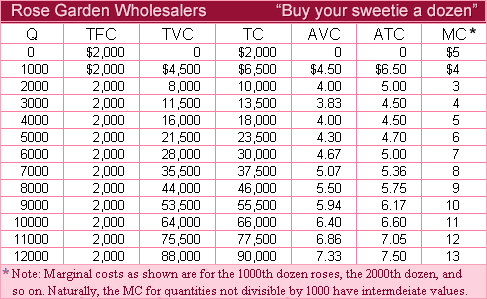
When the wholesale price P = $5 per dozen roses, this purely competitive rose farm maximizes profit through producing ___ dozen roses at a total (loss or profit) of $___. (1) zero; loss; $2000. (2) 2000; loss; $1500. (3) 3000; profit; $1500. (4) 4000; profit; $4,500. (5) 4000; profit; $2,000.
935_Profits and Losses.png

Please choose the right answer from above...I want your suggestion for the same.

   Related Questions in Microeconomics

  • Q : Sunk cost Give the answer of following

    Give the answer of following question. Which of the following sayings associate most closely to the idea of sunk costs? 1) Don't cry over spilt milk. 2) A bird in the hand is worth two in the bush. 3) He who hesitates is lost. 4) Show me the money.

  • Q : Invisible-hand concept Choose Which one

    Choose Which one best describes the invisible-hand concept? 1) The desires of resource suppliers and producers to further their own self-interest will automatically further the public interest. 2) The nonsubstitutability of resources creates a conflict between private

  • Q : Problem on Labor Unions and Wages The

    The Industrial unions try to accomplish wage rates above the competitive level through: (i) Limiting the supply of labor to the industry. (ii) Raising the supply of labor. (iii) Raising the productivity of the labor in an industry. (iv) Member’s agreeing to work

  • Q : Price elasticity of demand coefficient

    A price elasticity of demand coefficient of infinity implies that: (w) the demand curve is horizontal. (x) each 1 percent price hike elicits a 1 percent increase in revenue. (y) total revenue increases proportionally as a firm increases its price. (z)

  • Q : Define factor market Factor market : It

    Factor market: It comprises of factors of production namely land, labor, capital and associations.

  • Q : Short-run equilibrium of purely

    At the price P1, the given figure of purely competitive cranberry industry is within: (w) long-run equilibrium. (x) short-run equilibrium. (y) market period disequilibrium. (z) short-run disequilibrium. <

  • Q : When is demand perfectly price inelastic

    Demand is perfectly price inelastic when the quantity demanded for Pixie’s cheesy fried grits is of: (w) zero. (x) P4. (y) P2. (z) More information is required.

    Q : Problem on Dynamics When drought causes

    When drought causes ranchers to in advance take cattle to the market, one short-run tendency will be for: (1) The demand for beef to rise. (2) Restaurants to experience shortages of the steak. (3) Prices for pork and lamb to decline. (4) Corn and wheat to become less

  • Q : When price of a good or resource drops

    When the price of a good or resource drops/falls, the demands for: (i) that good or resource rise. (ii) Complementary goods or resources reduce. (iii) Replacement of goods or resources reduces. (iv) Luxury goods and inferior resources drop/fall.

  • Q : Measures of Poverty Line The poverty

    The poverty line is: (1) about $15000/year for a family of two in 2006. (2) an index which varies depending on family characteristics. (3) dependent only on the size and income of a family. (4) about $12500/year for a family of four in 2006. (5) the p