--%>

Profit maximizing strategy

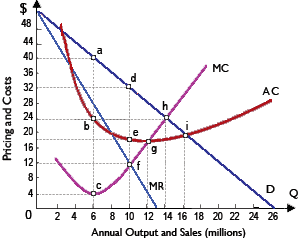
Prohibition Corporation would exactly break-even on its St. Valentine’s Day software when, in place of correctly identifying its profit maximizing strategy, this: (1) operated at point i, charging just $20 per copy and producing 16 million copies. (2) priced the software at $48 and sold just 1.8 million copies. (3) charged $32 per copy and sold 10 million copies. (4) produced 13 million copies as well as sold them for $27 apiece.
1906_software of Elasticity.png

Hey friends please give your opinion for the problem of Economics that is given above.

   Related Questions in Microeconomics

  • Q : Total revenue on profit-maximizing

    Total revenue roughly for the profit-maximizing lumber mill equivalents: (i) $1700 daily. (ii) $2500 daily. (iii) $3500 daily. (iv) $4590 daily. (v) $6000 daily.

    Q : Signals for sellers Can someone help me

    Can someone help me in finding out the right answer from the given options. The signals for sellers to lower the market price comprise: (i) Fast depletion of goods from the retail store shelves. (ii) Producers encompass more orders than they can hold.

  • Q : Problem of Moral Hazard by an individual

    The problem of moral hazard is finest explained by the behavior of an individual who: (1) Dates two distinct people on the sly. (2) Doesn’t lock up her car since theft is covered by the insurance. (3) Steals to support the serious drug habit. (4) Understates the

  • Q : Income of Development and Distribution

    The extent of equality within the income distribution of a country seems to depend most heavily upon the degree of: (w) economic development in the country. (x) progress towards national socialism. (y) central economic planning. (z) fertility of the a

  • Q : Felicific calculation of utilitarianism

    The supposition that a ‘felicific calculation’ gives a proficient guide for fitting punishment to the crime committed is an integral portion of: (1) Gresham’s Law that ‘Bad will drive out Good’. (2) Jeremy Bentham’s utilitarianism.

  • Q : Derived Demand Can someone help me in

    Can someone help me in finding out the right answer from the given options. Demands for the productive resources are eventually ‘derived’ from the: (i) marginal utility they directly produce. (ii) Demands for the consumer services and goods. (iii) Disutili

  • Q : Problem on hyperinflation In the year

    In the year 2015, people begin utilizing dollar bills to wipe up messes as hyperinflation has driven the price of ‘real’ paper towels to $7,000 a roll. This is an illustration of: (1) The income result. (2) Diminishing the marginal utility

  • Q : Sum of Monopolistic Exploitation Sum of

    Sum of the monopolistic exploitation across all workers tends to rise however a firm as well functions at a more socially and economically proficient level of output and employment whenever the firm is capable to engage in: (1) Blacklisting in its dea

  • Q : Microeconomics Question #2 Consumer

    Question #2 Consumer Demand. How to answer questions from a-g iii. I belive the MRS is 2y/x for B. But not sure

  • Q : Long run and short run costs I have

    I have difficulty in this question. Provide me correct solution of this to submit my assignment. What is the relationship among long run and short run costs?