--%>

Profit-maximizing price

The profit-maximizing price for “Silver Screen Classic” of Nostalgia DVDs is: (i) $6 per copy. (ii) $10 per copy. (iii) $12 per copy. (iv) $16 per copy. (v) $20 per copy.
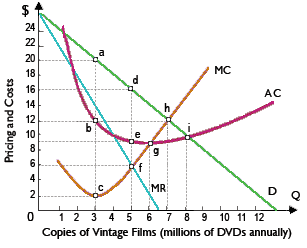
950_maximize profit.png

I need a good answer on the topic of Economics problems. Please give me your suggestion for the same by using above options.

   Related Questions in Microeconomics

  • Q : Adverse Selection in buying a defective

    Whenever an on-line seller deceived you into buying a faulty ‘fully preloaded’ iPod, you encompass lost since of: (1) Moral hazard. (2) Rational ignorance. (3) Adverse selection. (4) Bait-and-switch deception. (5) Cognitive dissonance.

    Q : When is minimum wage legislation LEAST

    Minimum wage legislation is LEAST probable to stimulate: (w) higher teenage unemployment. (x) raised racial discrimination. (y) surpluses of unskilled workers. (z) decreased wage incomes for unskilled workers who keep their jobs.

    Q : Constant cost industry in competitive

    When brick-making is a constant cost industry, during the long run this firm is probable to experience: (i) a severe shrinking of economic profit to zero. (ii) a decline in the price of bricks to approximately eight cents apiece. (iii) increased compe

  • Q : Output level of profit maximizing of

    The profit maximizing competitive firm in illustrated graph will: (i) produce output level q5. (ii) minimize total costs by producing output level q3. (iii) experience fixed costs equal to 0P3fq4. (iv) produce output level q4. (v) inevitably experienc

  • Q : Economic profits by potential customers

    When you lease a building for five years and rapidly achieve economic profits since it is located conveniently for potential customers: (1) you could capitalize some of these pure profits when you sold your business along with a sublease at the ending

  • Q : Investment by profit-maximizing pure

    For such illustrated figure profit-maximizing pure competitor, there area aPed shows: (1) fixed cost (TFC). (2) average fixed cost (AFC). (3) the lowest possible economic loss. (4) maximum economic profits. (5) the rate of return on investment. <

  • Q : Monopolies in short run Within the

    Within the short run, there monopolies can: (i) make economic profits. (ii) break even. (iii) make economic losses. (iv) All of the above. Hey friends please give your opinion for the problem of Economics <

  • Q : Labor-Leisure Tradeoffs When leisure is

    When leisure is a normal good, then the demand for leisure: (i) Differs directly with the income. (ii) Has declined sharply as World War II. (iii) Is positively associated to the average age of population. (iii) Shifts left-ward as an outcome of technological advances

  • Q : Borrower and lenders in financial

    Financial institutions like banks perform as intermediaries. They lend their savings of depositors to final borrowers, charging more interest to borrowers than they pay to depositors, who are the eventual providers of loans. How does it decrease the <

  • Q : Monopolistic-Exploitation problem In

    In equilibrium for the price maker firm, the rate of monopolistic exploitation is the difference between: (i) P and MR. (ii) P and MC. (iii) Total revenue and net cost per unit of output. (iv) Output price and rate of monopsonistic exploitation. (v) VMP and MRP.