--%>

Profit-maximizing output for economic profit

Babble-On maintains world-wide patents for software which translates any of 314 spoken languages in text, along with automatic audio and text translations within any of the other three-hundred-thirteen languages. When Babble-On produces its profit-maximizing output, this is demonstrated as: (w) operating in the long run. (x) realizing an economic profit equal to area P3P1cd. (y) operating irrationally since this should shut down. (z) incurring total variable costs equal to 0P3dq3.
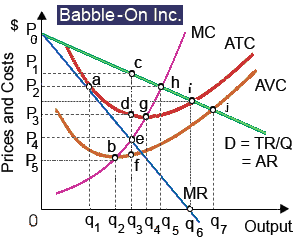
2088_Market Power.png

How can I solve my Economics problem? Please suggest me the correct answer.

   Related Questions in Microeconomics

  • Q : Marginal revenue of purely competitive

    When boosting output by hundred units raises total revenue by $1200, in that case a purely competitive firm’s marginal revenue the same as: (w) $1,200. (x) $120. (y) $12. (z) $120,000. I need a good answer on

  • Q : Excise tax at highest average rate At

    At the highest average rate an excise tax will tax low incomes while: (1) only luxuries are taxed. (2) goods along with the highest income elasticity of demand are exempt. (3) goods along with the lowest income elasticity of demand are exempt. (4) no

  • Q : What is the meaning of ex-ante savings

    Meaning of ex-ante savings: Ex-ante savings are expected savings or planned savings.

  • Q : Taxes on pure land rent Taxes on pure

    Taxes on pure land rents: (1) especially distort economic behavior. (2) are forward shifted to consumers. (3) transfer income from the public treasury to private landowners. (4) are allocatively neutral relative to most alternative taxes. (5) are over

  • Q : Labor Unions-History problem Can

    Can someone please help me in finding out the accurate answer from the following question. The Carpenter's Society of the Philadelphia: (i) Was established in the year 1924. (ii) Functioned government contracts throughout the Great Depression. (iii) Bargained for the

  • Q : Problem on relative monetary values The

    The relative monetary values an individual consumer subjectively puts on containing a bit more or less of a good are termed as: (i) Consumer preferences. (ii) Demand prices. (iii) Psychic prices. (iv) Subliminal prices. (v) Consumer utilities.

  • Q : Illustration of Inferior Goods I have a

    I have a problem in economics on Illustration of Inferior Goods. Please help me in the following question. When the amount of a good your family purchases raises as your family income reduce, then the good is a/an: (i) Durable goods. (ii) Inferior goo

  • Q : Explain the term GNI per capita How do

    How do you explain the term GNI per capita?

  • Q : Problem on Labor History-Yellow Dog

    The yellow dog contracts are now proscribed, however in the early 20th century such agreements among employers: (i) Not to purchase intermediate goods made by unionized labor hindered labor market transformations. (ii) And workers stating that the workers would not jo

  • Q : Determine Gini index in Loren curve

    Since lifetime earning patterns differ, in that case the Gini index will: (1) continue to rise over time. (2) never reach zero or perfect equality. (3) remain constant. (4) surpass 100 in the near future. (5) be lower for developing countries than for