--%>

Profit maximization of an output level

Profit is maximized when this brickyard manufactures an output level of: (1) 6,000 generic bricks daily. (2) 7,000 generic bricks daily. (3) 15,000 generic bricks daily. (4) 17,000 generic bricks daily. (5) 20,000 generic bricks daily.
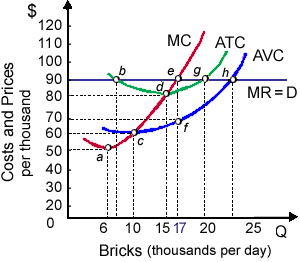
108_Profit Maximization1.png

Can anybody suggest me the proper explanation for given problem regarding Economics generally?

   Related Questions in Microeconomics

  • Q : Price signalling reallocations in use

    An illustration of prices signalling desirable reallocations would happen while rising product demand leads to rising: (w) levels of investment during the economy. (x) employment of resources producing such good. (y) shifts of resources within other outputs. (z) quick

  • Q : Labor Unions-Secondary Boycotts

    Whenever a firm consists of a collective bargaining agreement with its employees and unionized employees reject to handle the goods generated by other firms if the workers for other firms are on strike, then the unionized employees are engaged in the: (1) Secondary bo

  • Q : Existence of Diseconomies I have a

    I have a problem in economics on Existence of Diseconomies. Please help me in the following question. Diseconomies of the scale exist if: (1) Price reduces as more units are sold. (2) Total costs reduction as output raise. (3) Average costs raise as output rises. (4)

  • Q : Tastes and Preferences in travel

    Can someone help me in finding out the right answer from the given options. Raised ‘love boat’ ticket sales in response to a sequence of stunning travel commercials point out a raise in the: (i) Quantity of romantic vacations demanded. (ii) Demand for the

  • Q : Kinked Demand by decreasing price In

    In this kinked demand curve model as in given graph, when this firm operated at point a and lowered its price by P2 to P1 and other firms in the industry also lower prices, in that case this firm will move from point a to: (w) po

  • Q : Altering the value of place for better

    The trucker who hauls fresh oranges from Florida to the New York raises the value of oranges by directly and productively changing their: (i) Time of consumption. (ii) Location or Place. (iii) Ownership or Possession. (iv) Form and substance.

    Q : Problem on decline of demand The

    The automakers slashed prices and gave ‘zero percent financing’ throughout the year 2001-2003 recession. An expected outcome was: (1) The decline in the demand for utilized cars. (2) enhanced maintenance of older cars by their owners. (3) Buyers purchasing

  • Q : Market demand curve of pure monopolist

    A pure monopolist faces as: (w) a perfectly elastic demand for its product because it can't affect market price. (x) a perfectly inelastic demand for its product. (y) the market demand curve for its product. (z) a constant marginal cost curve.

  • Q : Freedom of entry-exit in long run

    Contestable markets and purely competitive markets share the feature of: (w) collusive behavior of huge firms. (x) freedom of entry and exit into the long run. (y) widespread product differentiation. (z) persistent economic profits.

    Q : Effect of percentage change in price

    Give the answer of following question. When the percentage change in price is greater than the resulting percentage change in quantity demanded: A) a decrease in price will increase total revenue. B) demand may be either elastic or inelastic. C) an increase in price