--%>

Production possibilities curves

Give me answer of this question. The production possibilities curves following suggest that: A) West Mudville should specialize in, and export, baseball bats. B) West Mudville should specialize in, and export, both baseballs and baseball bats. C) East Mudville should specialize in, and export, baseball bats. D) workers will try to immigrate from West Mudville to East Mudville.
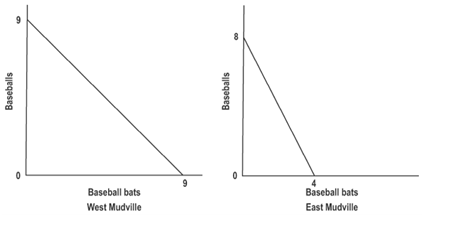
2439_8.png

   Related Questions in Microeconomics

  • Q : Drive rivals out of business A firm may

    A firm may temporarily lower prices as well as earn negative profits in trying to: (w) drive rivals out of business. (x) find rivals to lower prices. (y) maximize current profit. (z) A rational firm would not do this.

    Q : Domestic production possibilities curve

    Refer to the following domestic production possibilities curve for Karalex. The gain to Karalex from specialization and international trade is represented by a move from: 1) A to B. 2) C to A. 3) C to D. 4) B to E.

    Q : Merits of regional integration

    Elucidate the merits of regional integration?

  • Q : Marginal tax rate under negative income

    The marginal tax rate upon earned income under negative income tax system demonstrated in this figure is: (1) 15 percent. (2) 20 percent. (3) 25 percent. (4) 33.3 percent. (5) 50 percent.

    Q : Problem on competitive equilibrium

    The economy consists of an equal number of smokers (S-types) and asthma sufferers (A-types). Good 1 is cigarettes, good 2 is “other stuff.” S-types have the utility function: xS1 + xS

  • Q : Principal-Agent Problems-Institutions

    According to the John Kenneth Galbraith, the modern corporate planning: (i) Aims at decreasing risks to the managers of main firms. (ii) Stresses the maximization of gains. (iii) Is much concerned with the social goals. (iv) Maximizes the social welfare.

  • Q : Present Value of a Perpetuity When the

    When the interest rate is 5%, in that case the present value of a perpetuity which pays $500 each year beginning a year by today equals: (1) $500. (2) $1000. (3) $2500. (4) $5000. (5) 10,000. Can s

  • Q : Taxes on pure land rent Taxes on pure

    Taxes on pure land rents: (1) especially distort economic behavior. (2) are forward shifted to consumers. (3) transfer income from the public treasury to private landowners. (4) are allocatively neutral relative to most alternative taxes. (5) are over

  • Q : Monopsonist-Wage discriminate Compared

    Compared with the price taker in labor market, the monopsonist which can’t wage discriminate will: (i) Hire more labor at any specified wage. (ii) Hire less labor at any wage. (iii) Pay a higher wage for any specified quantity of labor. (iv) Hire more prolific l

  • Q : Demand of consumers-supply of seller

    Consumers’ demand prices and sellers’ supply prices may be different in equilibrium due to: (w) arbitrage. (x) expectations about availability. (y) the invisible hand. (z) government subsidies or tax wedges.