--%>

Production and distribution of income in purely competition

When the distributions of income were suitable, when there were no externalities, and when the economy was purely competitive, in that case market forces would yield production and distribution of penicillin consequent to: (i) point a. (ii) point b. (iii) point f. (iv) point d. (v) point g.
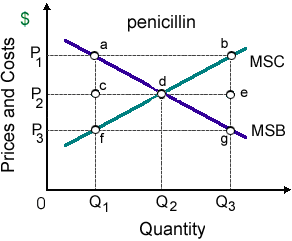
2392_Efficiency and Welfare.png

How can I solve my Economics problem? Please suggest me the correct answer.

   Related Questions in Microeconomics

  • Q : Inverse relationship in Law of Demand

    The law of demand signifies to: (i) The direct relationship accessible between quantity and prices demanded. (ii) The inverse relationship accessible between quantity demanded and opportunity cost. (iii) How demand shifts due to modifications in price

  • Q : Paying bond by given interest rate When

    When you buy a bond when the interest rate is 10 percent and sell it while the interest rate is 15%, you will obtain: (w) less than you paid for the bond. (x) more than you paid for the bond. (y) identical amount that you paid for the bond. (z) income

  • Q : Supply curve for perishable goods The

    The supply curve for perishable goods which, once produced, can’t be stored in inventory is generally functioned as perfectly price inelastic into the: (i) short-run. (ii) intermediate period. (iii) long-run. (iv) market period. (v) fiscal year

  • Q : Important of economies of scale to

    Karl Marx's prediction which competition ultimately leads to monopoly is most likely to be valid while: (w) diseconomies of scale discourage competition. (x) there are always constant returns to scale. (y) economies of scale are important relative to

  • Q : Unregulated monopoly economic efficiency

    Mainly economists object to unregulated monopoly primarily since: (w) economies of large scale operation may be attained. (x) technological advance may be fostered. (y) economic efficiency would be promoted. (z) economic efficiency may be decreased.

  • Q : Causes for diminishing returns to factor

    What are the causes for diminishing returns to factor? Answer: 1) Over utilization of

  • Q : Non discriminating firm-monopsony power

    The non discriminating firm with monopsony power in labor market confronts the: (1) Wage rate which consistently surpasses the marginal revenue. (2) MRP less than w. (3) MFC which surpasses w. (4) Monopolistic seller of firm's output. (5) MRP more tha

  • Q : Problem on cost curve The following

    The following diagram illustrates the short-run average total cost curves for five different plant sizes of any firm. The shape of each curve reflects: 1) increasing returns, followed by diminishing returns. 2) economies of scale, followed by diseconomies of scale. 3)

  • Q : Average expected revenue by selling

    Each firm will shut down whenever the average expected revenue through selling output cannot equivalent or exceed expected as: (i) average total cost. (ii) marginal cost. (iii) average fixed cost.  (iv) average variable costs.

  • Q : Competition in Labor Markets The

    The horizontal labor supply curve signifies that: (i) The supply of labor is perfectly inelastic. (ii) The firm can hire as much labor as it requires at going wage rate. (iii) Labor and capital are in the fixed supply. (iv) Marginal physical product of the labor is co