--%>

Produce output by zero marginal reveune

When LoCalLoCarbo, the favorite corporation of fad dieters,in that case produces output q* [that where is marginal revenue is zero] as: (1) LoCalLoCarbo’s total revenue is at its highest possible level. (2) expanding output to q4 would cause total revenue to fall. (3) LoCalLoCarbo could increase its profit by decreasing production because MC > MR. (4) the consequent point on the demand curve facing LoCalLoCarbo has unitary price elasticity. (5) All of the above.
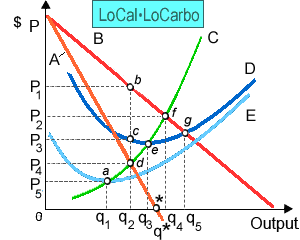
1183_Market Power and Marginal Revenue.png

Please choose the right answer from above...I want your suggestion for the same.

   Related Questions in Microeconomics

  • Q : Price elasticity of demand on mid point

    When 900 tons of gourmet coffee beans are sold per month at $5.40 per pound but sales drop to 500 tons while its price rises to $7.20 per pound, the price elasticity of demand for that coffee based upon the mid-point or say arc formula is: (i) 2.0. (i

  • Q : Market supplies of labor withinin long

    During the long run, the labor supply curve facing a main industry: (w) will always be positively associated to the wage rate. (x) will slope upward only when individual labor supply curves slope upward. (y) can be backward bending at very high wage r

  • Q : Rises price elasticity of demand for a

    The price elasticity of demand for a good will tend to rise as the: (i) number of obtainable substitutes increases. (ii) consumer income level increases. (iii) good is a less significant budget item. (iv) time permitted for response decreases. (v) ela

  • Q : Strategic Barriers to Entry in

    Extravagant and costly marketing through established firms in an oligopoly is probable to: (w) encourage entry by other profit maximizing firms. (x) raise the minimum efficient scale of production for new entrants. (y) act as a regulatory barrier of entry. (z) increas

  • Q : Question based on type of economy An

    An industry comprised of a small number of firms, each of which considers the potential reactions of its rivals in making price-output decisions is called: A) monopolistic competition.  B) oligopoly.  C) pure monopoly.  D) pure competition.

  • Q : Justified investment by paying income

    When the price of each of the given assets is $10,000 and the interest rate is 10%, then investment is most justified for: (1) a perpetuity paying $900 annually. (2) a machine with a 3 year life which can be leased to an outsider for $10 per day. (3) an income stream

  • Q : Demand and supply problem Assume that

    Assume that the demand for jeans rises. At similar time, since of an increase in price of cotton, the supply of jeans reduces. How will it influence the price and amount sold of jeans?

    Q : Labor History-Yellow Dog Contracts

    Can someone help me in finding out the right answer from the given options. The worker who signed a yellow dog contract in the year 1920s agreed: (1) To support the union’s feather-bedding efforts. (2) Not to work with the ‘scab’ non-union strike-bre

  • Q : Percentage changes in quantity supplied

    The price elasticity of supply can be very approximately computed as the percentage change within: (w) responsiveness of price to variations within the quantity supplied. (x) quantity divided through the intercept coefficient of the supply curve. (y)

  • Q : Kinked demand curve about product price

    When an oligopolist is aware about the firm faces a kinked demand curve, this: (1) may cut price along with little expected reaction by rivals. (2) can avoid consumer demand and preferences. (3) may keep product price despite large ch