--%>

Problem related to mass flow rate

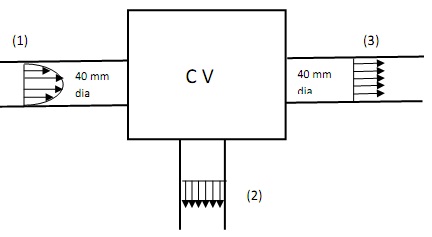
Water flows via a control volume as illustrated in the figure below. At Section (1) the diameter is 40 mm and the velocity profile is given by the V(r) = 10 (4 – r2) m/s, here r is the  distance from the centerline. At Section (2) the mass flow rate is 10 kg/s and at Section (3) the diameter is about 40 mm and the flow is uniform. Compute the uniform velocity at the section (3). The Density of water is taken as 1000 kg/m3
224_uniform velocity.jpg

   Related Questions in Mechanical Engineering

  • Q : What is Cotter joint Cotter joint :

    Cotter joint: These kinds of joints are employed to connect two rods that are under compressive or tensile stress. The ends of rods are in the way of a socket and shaft which fit altogether and the cotter is driven into a slot which is common to both

  • Q : Petroleum technology theories for the

    theories for the origin of petroleum, methods for detection of petroleum deposits, fractional distillation

  • Q : Arena Are you able to assist with these

    Are you able to assist with these two assignments in Arena simulation below? You can use the Basic Process instead of Blocks and Elements. An office of state license bureau has two types of arrivals. Individuals interested in purchasing new plates are characterized to have inter-arrival times dis

  • Q : Problem on turbulent flow The

    The approximate equation for the velocity distribution in a rectangular channel with the turbulent flow is 655_turbulent flow.jpg

    Q : Difference between projectile motion

    Difference between projectile motion and rocket motion:A projectile has no motor or rocket on it, therefore all of its momentum is provided to it as it is launched. An illustration of a projectile would be pen which you throw across a room.

  • Q : Welding rod 7018 State abbreviation of

    State abbreviation of the welding rod 7018?

  • Q : Problem on flow rates Water flows at 40

    Water flows at 40 m/s from the jet of area of cross-section of 0.008 m2 on to a flat plate as shown in the figure. Determine the force F normal to the plate, and also the flow rates out of the plate.

    Q : Laws of Thermodynamics Describe all the

    Describe all the laws of the Thermodynamics?

  • Q : Cavitation elimination by Pump How

    How Cavitation is eliminated by the Pump?

  • Q : Problem on pressure rise of a water tank

    The water level in a tank is about 20 m above the ground. A hose is joined to the bottom of the tank, and the nozzle in the end of the hose is pointed to straight up. The tank is at sea level, and the water surface is open to the environment. In the line leading from