--%>

Problem on work of compression

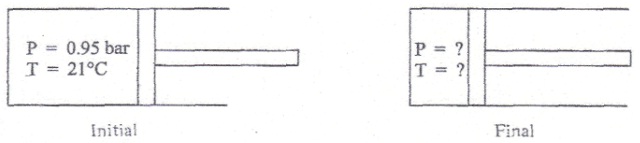
A diesel engine operates devoid of a spark plug by using the high-temperature gas produced throughout the compression stage to ignite the fuel. During a typical compression, pure air that is originally at 21 °C and 0.95 bar is reversibly and adiabatically compressed to 1/20 of its original(actual) volume by the piston, as shown in the figure below.

a) If air is assumed to obey the ideal gas equation of state, find out the pressure and temperature in the cylinder at the end of the compression. The constant-pressure heat capacity of air varies with temperature and is given by

Cp/R = 3.3 + 6x10⁻⁴

b) What is the work of compression in J/mol of air?

c) Is the ideal gas law a good approximation in this case? Why?
2455_ideal gas law.jpg

   Related Questions in Mechanical Engineering

  • Q : Problem related to mass flow rate Water

    Water flows via a control volume as illustrated in the figure below. At Section (1) the diameter is 40 mm and the velocity profile is given by the V(r) = 10 (4 – r2) m/s, here r is the  distance from the centerline. At Section (2) the mass flow r

  • Q : Problem on damping coefficient Vertical

    Vertical suspension system of a car can be modeled as single degree of the freedom system. Consider that the car with mass m consists of four shock absorbers with equal stiffness and damping of k and c, corresspondingly: (a) Due to

  • Q : Problem on work of compression A diesel

    A diesel engine operates devoid of a spark plug by using the high-temperature gas produced throughout the compression stage to ignite the fuel. During a typical compression, pure air that is originally at 21 °C and 0.95 bar is reversibly and adiabatically compress

  • Q : Solar Thermal systems Explain the two

    Explain the two Solar thermal DHW and Solar DHW Solar thermal systems n brief?

  • Q : Powder Technology Explain the term

    Explain the term Powder Technology?

  • Q : Life expectancy in Product design

    Life expectancy: This part of the specification will state how long the product should remain in working order provided the customer gives reasonable care and maintenance. Also take into account technological advances and ongoing improvements that wou

  • Q : Causes and consequences of dynamic

    Discuss the causes and consequences of dynamic loading on structures based on two real examples. Support your discussion with proper diagrams or sketches. Your discussion shall include the time and location of the event, type and source of dynamic loa

  • Q : Ergonomics in product design

    Ergonomics: This is concerned with how easy (comfort, complexity) the product is to use by the targeted market. Physical human dimensions must be considered when designing the driver's seating, instruments, and controls in a car. Slight variations bet

  • Q : Problem on degree of freedom Draw a

    Draw a frequency-response curves for a damped single degree of freedom system subjected to a harmonic excitation under three different damping ratios. System has a natural frequency of ωn as the forcing frequency of the excitation is ω. Describe

  • Q : Efficient use of waste heat and

    Efficient use of waste heat and renewable heat sources 1. Describe how you might recover heat from (a) a process exhaust gas stream (e.g. from an oven) and (b) a process warm water stream (e.