--%>

Problem on slope of demand curve

The demand curve for DVD games is a straight line, therefore its slope: (1) Is constant, although price elasticity of demand drops/falls as output increases. (2) Price elasticity are both stable. (3) Is constant, although price elasticity of demand increases as the price drops/falls. (4) Differs to compensate for modifications in elasticity.
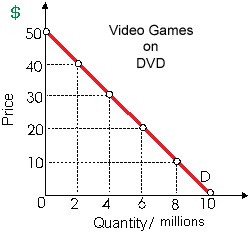
2364_11.jpg

Can someone help me in getting through this problem.

   Related Questions in Macroeconomics

  • Q : Equal Marginal advantage law Assume

    Assume that you receive $18 worth of “jollies” (that is, satisfaction, utility or pleasure) from the very first hole of golf played on a particular day, and that your extra jollies from succeeding holes drops $1 for each and every hole played. You should p

  • Q : Definition of surplus Definition of

    Definition of surplus: It is a condition in which quantity supplied is more than quantity demanded. To remove the surplus, producers will minimize the price till the market reaches to equilibrium.

  • Q : Problem on Imperfect information

    Imperfect information at times causes consumer’s attempts to maximize their contentment to fail since: (i) Prospects are imperfectly realized, and trial-and-error prototypes can lead to mistakes. (ii) Sellers might exploit asymmetric information

  • Q : Explain Shut Down Price Explain the

    Explain the term Shut Down Price? Illustrate it.

  • Q : Cost-push inflation Describe cost-push

    Describe cost-push inflation and its major source.

  • Q : The failure of the Supercommittee

    Question: Some commentators have argued that the failure of the "Supercommittee" is good thing for the economy?  Do you argree? Answer:

    Q : Difference on consumer willing to pay

    I have a problem in economics on Consumer Surplus-Difference consumer willing to pay and what actually pay. Please help me in the following question. The consumer surplus signifies to the difference among the: (i) Satisfaction of wealthy people and th

  • Q : Problem on production function Consider

    Consider a model economy with a production function Y = K0.2(EL)0.8, where K is capital stock, L is labor input, and Y is output. The savings rate (s), which is defined as

  • Q : Tariffs Tariffs: -are also called

    Tariffs: -are also called import quotas. -may be imposed either to raise revenue (revenue tariffs) or to shield domestic producers from foreign competition (protective tariffs). -are per unit subsidies designed to promote exports. -are excise taxes on goods exported abroad.

  • Q : Formula for Fiscal deficit Fiscal

    Fiscal deficit: Fiscal deficit is stated as the surplus of total expenditure over total receipts, apart from borrowings. Fiscal deficit = Total expenditure (Rev. Exp. + Cap. Exp.) – Total Receipts