--%>

Problem on queuing diagram

Draw a queuing diagram for the systems below and describe them using Kendall’s notation:

A) Single CPU system

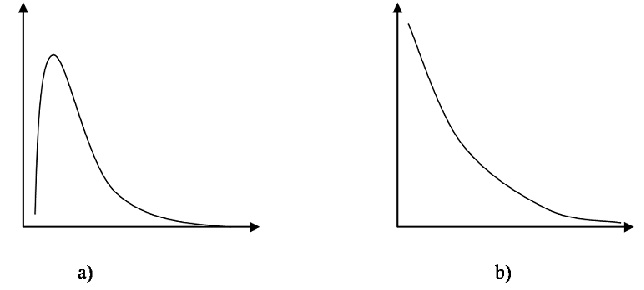
B) 4 CPU system, where the arrival times are distributed according to fig a and the service times according to fig b. Requests are serviced according to priorities, with higher priority request pre-empting lower priority ones.

C) A system comprising three web servers, to which requests are randomly directed. Each of the servers contains two CPUs.
2098_curve.jpg

   Related Questions in Basic Statistics

  • Q : Creating Grouped Frequency Distribution

    Creating Grouped Frequency Distribution: A) At first we have to determine the biggest and smallest values. B) Then we have to Calculate the Range = Maximum - Minimum C) Choose the number of classes wished for. This is generally between 5 to 20. D) Find out the class width by dividing the range b

  • Q : STATISTICS Question This week you will

    This week you will analyze if women drink more sodas than men.  For the purposes of this Question, assume that in the past there has been no difference.  However, you have seen lots of women drinking sodas the past few months.  You will perform a hypothesis test to determine if women now drink more

  • Q : State Kendalls notation

    Kendall’s notation:  A/B/C/K/m/Z A, Inter-arrival distribution M exponential D constant or determ

  • Q : FIN512 Entrepreneurial Finance Chapter

      Chapter 6: Discussion Question: #4 p. 223  It is usually easier to forecast sales for a seasoned firm contrast to an early-stage venture because an early-stage venture has limited access to bank credit lines, sho

  • Q : Statistics basic question This week you

    This week you will analyze if women drink more sodas than men.  For the purposes of this Question, assume that in the past there has been no difference.  However, you have seen lots of women drinking sodas the past few months.  You will perform a hypothesis test to determine if women now drink more

  • Q : What is Interactive Response Time Law

    Interactive Response Time Law: • R = (L/X) - Z• Applies to closed systems.• Z is the think time. The time elapsed since&nb

  • Q : Data Description 1. If the mean number

    1. If the mean number of hours of television watched by teenagers per week is 12 with a standard deviation of 2 hours, what proportion of teenagers watch 16 to 18 hours of TV a week? (Assume a normal distribution.) A. 2.1% B. 4.5% C. 0.3% D. 4.2% 2. The probability of an offender having a s

  • Q : MANOVA and Reflection Activity

    Activity 10:   MANOVA and Reflection   4Comparison of Multiple Outcome Variables This activity introduces you to a very common technique - MANOVA. MANOVA is simply an extension of an ANOV

  • Q : Creating Grouped Frequency Distribution

    Creating Grouped Frequency Distribution: A) At first we have to determine the biggest and smallest values. B) Then we have to Calculate the Range = Maximum - Minimum C) Choose the number of classes wished for. This is generally between 5 to 20. D) Find out the class width by dividing the range b

  • Q : Cumulative Frequency and Relative

    Explain differences between Cumulative Frequency and Relative Frequency?