--%>

Problem on prisoners dilemma game

Lets assume an infinitely repeated prisoner’s dilemma game by two players. The resulting payoffs at each phase by the actions of two players are illustrated below in the table (payoffs are symbolized like (payoff for player 1, payoff for player 2)). Two players find out their strategies simultaneously and independently to maximize the expected payoffs of their own based on their information. The game is potentially infinitely repeated, though the game ends at a probability of 1–x (0≤1–x≤1) in every phase (that is, such players continue to play this game at the probability of x). There is no discount rate for the future payoffs (that is,  both players weight current and future payoffs equally).
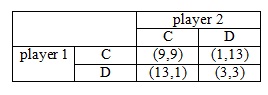
1139_game.jpg

(a) Assume two players adopt a Trigger Strategy (Play C in the first phase In the tth phase(t≥2), if the outcome of all t–1 preceding stages has been (9, 9), then play C; or else play D). Find the range of x which makes cooperation self-sustainable.

(b) Assume two players adopt a Tit for Tat Strategy (TFT) (Play C in the first phase And then, do whatever the other player did at the previous phase). Find the range of x which makes cooperation self-sustainable.

   Related Questions in Business Economics

  • Q : Explain how women expanded production

    Explain how women expanded production possibilities?

  • Q : Meaning of Economic Development

    Question Discuss what "economic development" means in the context of this game? (Hint: How do you win, and what do you have at the end of the game that you did not have at the beginning of the game?)

  • Q : Illustrate the Risks involved with bonds

    Illustrate the Risks involved with bonds?

  • Q : Distinguish between the resource market

    Distinguish between the resource market and product market in the circular flow model.  In what way are businesses and households both sellers and buyers in this model?  What are the flows in the circular flow model?

  • Q : Circular flow model of the private

    I have a problem in economics on Circular flow model of the private sector. Please help me in the following question. The simple circular flow model of private sector doesn’t comprise: (i) Firms. (ii) Product markets. (iii) Government agencies.

  • Q : Proper control on capital budgeting

    Write down the steps carried out for proper control on capital budgeting process?

  • Q : Demand for bagels rises dramatically

    Explain the demand for bagels rises dramatically while the demand for breakfast cereal falls?

  • Q : Adopting policy of paying efficiency

    The expected losses to workers by shirking are increased while a firm adopts a policy of: (1) dividing productive tasks therefore the division of labor is optimal. (2) paying efficiency wages that exceed market-clearing wages. (3) avoiding legal liability from not wri

  • Q : Allocative Mechanisms-market based

    The market-based economic system: (1) Appears to be ‘natural’ as it has existed in all societies. (2) Has dominated the economic relationships in United States since from the year1492. (3) Guided resource allocation in middle ages. (4) Is

  • Q : Show that students who study more hours

    Suppose studies show that students who study more hours receive higher grades.  Is there any relationship which guarantees that any particular student who studies longer will get higher grades?