--%>

Problem on pressure rise of a water tank

The water level in a tank is about 20 m above the ground. A hose is joined to the bottom of the tank, and the nozzle in the end of the hose is pointed to straight up. The tank is at sea level, and the water surface is open to the environment. In the line leading from the tank to the nozzle is a pump, that rises the pressure of water. If the water jet increases to a height of 27 m from the ground, then find out the minimum pressure rise that is supplied by the pump to the water line.
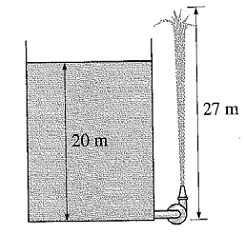
828_pressure rise.jpg

E

Expert

Verified

Entry and exit losses at the pump and nozzle are neglected since no data is given

The Bernoulli’s equation

P1/δg + V12/2g +z1 = P2/δg + V22/2g +z2 + Losses (L) – (i) 
P1/δg =  pressure head V2/2g =velocity head Z=  height

Assuming an air  density of 1.225 Kg/m3

Pressure at (2) = δa gh
                      = 1.225 x 9.81x 7
                      = 84.12 Pa ( below  atmosphere

P2 =Absolute pressure at (2)  = Atmospheric  pressure – 84.12
                    = 101.325 x 10³ – 84.12
                    = 101240.88 Pa
                    = δa g h + PP ( PP = pump pressure , SW= Water density)
                    =1000 x 9.81 x 20x+PP
                    =196200 + PP Pa

P1=Absolute pressure at (1)  = Patm  +  PP + 196200
                                           = 297525 +PP Pa
V1=V2 =0 a very negligible

Substituting  is (1) where δ =δw  = 1000 Kg/ m3 in the density of water
297525 +PP/ 1000g = 101240.88/ 1000g + 27
Solving for PP , it  comes out to be

PP = 68585.88Pa

   Related Questions in Mechanical Engineering

  • Q : What is carnot engine Explain the term

    Explain the term Carnot engine?

  • Q : Quantity in Product design specification

    Quantity: The total quantity of the product predicted and, more importantly, the production rates and batch sizes needed, should be specified. This will have implications for the types of manufacturing equipment and work organization necessary. It wil

  • Q : Laws of Thermodynamics Describe all the

    Describe all the laws of the Thermodynamics?

  • Q : Problem related to mass flow rate Water

    Water flows via a control volume as illustrated in the figure below. At Section (1) the diameter is 40 mm and the velocity profile is given by the V(r) = 10 (4 – r2) m/s, here r is the  distance from the centerline. At Section (2) the mass flow r

  • Q : Formulating equation of motion Figure

    Figure below shows a reinforced concrete framed building subjected to earthquake ground motion. The floor is rigid with the mass of each floor is shown in the figure. Formulate the equation of motion for this building. Prove that the natural frequenci

  • Q : Lubricating oil in turbines Except the

    Except the lubrication, explain the other two functions of the lubricating oil in some of the turbines?

  • Q : Problem on discharge head loss Water is

    Water is draining from the tank A to tank B. The elevation difference among the two tanks is 10 m. The pipe joining the two tanks has a sudden-expansion section as shown below. The cross-sectional area of the pipe from A is 8 cm2, and the area of the pipe f

  • Q : Benefits of gear drive Benefits of gear

    Benefits of gear drive: In general, gear drive is helpful for power transmission among two shafts, which are close to each other (at most at 1m distance). Additionally, it has maximum efficiency while transmitting power. It is resilient as compare to

  • Q : Problem on pressure rise of a water tank

    The water level in a tank is about 20 m above the ground. A hose is joined to the bottom of the tank, and the nozzle in the end of the hose is pointed to straight up. The tank is at sea level, and the water surface is open to the environment. In the line leading from

  • Q : Carburetion A carburetor's primary

    A carburetor's primary function is to mix proper proportions is?