--%>

Problem on opportunity cost of consumer goods

Refer to the given table. If the economy is producing at production alternative C, the opportunity cost of the tenth unit of consumer goods will be:
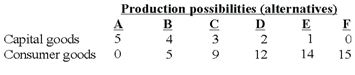
1106_3.png

1) 4 units of capital goods. 2) 2 units of capital goods. 3) 3 units of capital goods. 4) 1/3 of a unit of capital goods.

   Related Questions in Microeconomics

  • Q : Demand for loanable funds An increase

    An increase in the demand for loanable funds is reflected within an increase in the: (1) term structure of interest rates. (2) demand for money. (3) supply of bonds. (4) supply of money. (5) demand for bonds. I nee

  • Q : Total economic of profit or loss on

    When the wholesale price P = $7 per bushel of peaches, it purely competitive peach orchard maximizes profit via producing ___ bushels of peaches at a total economic of profit or loss totaling $___. (i) zero; loss; -$4,000. (ii) 2000;

  • Q : Example of perfectly price inelastic A

    A candy factory now produced 5.2 million packages of gummy worms as well as sold them for $1.27 each this annum. Last year this sold 4.7 million packages of gummy worms sold for $1.36 each. That firm’s gummy worms have demand which is: (1) perfe

  • Q : Market experience increases in quantity

    When equilibrium moves from point a to point b, the merely market experiencing raise within quantity supplied is demonstrated into: (w) Panel A. (x) Panel B. (y) Panel C. (z) Panel D.

    Q : Occurrence of nominal price lower then

    When the nominal price of apples at a remote orchard is fewer than at a local grocery store, in that case you are more probable to buy at the orchard when: (w) at all possible, because produce is invariably cheaper at the orchard. (x) you desire to bu

  • Q : Problem on labor monopsonist Can

    Can someone please help me in finding out the accurate answer from the following question. The labor monopsonist will hire labor up to the point where marginal: (i) Revenue product of the labor equivalents the wage. (ii) Resource c

  • Q : Effect of Increase in per capita income

    Rises in per capita income in the United States would be most probable to reduce the: (i) Demands for lard, pinto beans, and utilized tires. (ii) Excesses in the federal govt. budget. (iii) Supply of untrained labor relative to skilled labor. (iv) Tot

  • Q : Separation of the Economic Functions

    Separation of ownership or stockholders by control (management) into modern giant corporations tends to divide the economic functions of: (w) capitalists. (x) union leaders. (y) entrepreneurship. (z) bureaucrats. I

  • Q : Horizontal individual demand curves The

    The market demand curve is recognized by: (i) Vertically summing up individual demand curves. (ii) Graphing intersections of demand and supply over time. (iii) Holding quantity constant while summing up each price on demand curve. (iv) Horizontally summing up individu

  • Q : Externalities or public goods in purely

    A purely competitive economy along with no externalities or public goods tends to be efficient since: (1) firms try to act socially responsible. (2) government planners specify the best allocation. (3) all prices approximate marginal social benefits a