--%>

Problem on mechanical efficiency of the pump

The oil pump is drawing 25 kW of electric power while pumping oil with ρ = 860 kg/m3 at a rate of 0.1 m3/s. The inlet and outlet diameters of the pipe are of 8 cm and 12 cm, respectively. When the pressure rise of oil in the pump is measured to be 250 kPa and the motor efficiency is 90%, then find out the mechanical efficiency of the pump. Taking kinetic energy correction factor to be 1.05.
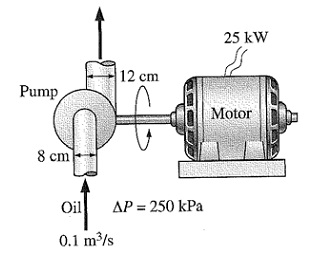
598_mechanical eff.jpg

E

Expert

Verified

Given:

Inlet Dia, Di = 8 cm = 8 x 10⁻² m
Outlet Dia, Do = 12cm = 12 x10-2m

Density of oil,  δ = 80Kg /m3

Flow rate Q = 0.1 m3/s

Pressure rise = 250KPa = 250 x10-3 Pa

Power supplied to the pump = 25Kw = 25 x 10-3 w

Motor efficiency = .90

Kinetic energy correction factor, α= 1.05

Inlet area Ai= Π/4 x D12=-Π/4 x (8 x 10-2)2 = 0.0804 m2
Outlet area A0= Π/4 x D02 = Π/4 x (12 x10-2)2= 0.1809 m2

Average evolution 
Vi = Q/Ai = 0.1/ 0.804 = 1.1235 m/s
V0 = Q/A0 = 0.1/ 0.1809 = 0.5526 m/s

A note of kinetic energy correction factor

K. E correction factor, α = (K. E /See based on actual velocity) / (K. E / See based on average velocity)

The factor α is used when the flow is viscous.

Applying Bernoulli’s equation at the inlet (i) i outlet (0) of the pump.

Pi/ δg + α1 Vi2/ 2g +zi + HP= P0 /δg +α2 Vo2/2g + Z0 + Hf .

Given  αi= α2= α= 1.05     (Z0 –Zi is considered negligible)
HP = head added by the pump
Hf = head loss due to friction

H= HP – Hf = P0–Pi / δg + α ( V02-V12)/ 2g
    = 250 x 103 / 1000 x 9.81 + 1.05 / 2 x 9.81 (0.55262  - 1.2435)
    = 25.42 m

Power of the pump PP= δg QH
            = 1000 x9.81x 0.1 25.42
            = 24934.85 w
            = 24.934Kw

Mechanical efficiency of the pump:

Case (1)  ηm = power output/power input = 24.934/ 25 = 99%
Case (2)  if the  motor is to get 25Kw  considering its efficiency  the supply should be of 25/ 0.9 KW

ηm = 24.934/ (25/0.9) = 89.67%

   Related Questions in Mechanical Engineering

  • Q : Solution A pump station has been

    A pump station has been designed to lift water out of a 6 metre deep pit (vented to atmosphere) via a centrifigual pump mounted at ground level. Liquid conditions 20OC Suction pipe work losses 2.0 metres NPSH safety factor 5.0 kPa Vapor pressure @ 20oC 0.25 metres (a) Calculat

  • Q : Arena Are you able to assist with these

    Are you able to assist with these two assignments in Arena simulation below? You can use the Basic Process instead of Blocks and Elements. An office of state license bureau has two types of arrivals. Individuals interested in purchasing new plates are characterized to have inter-arrival times dis

  • Q : Safe turbine operation For safe turbine

    For safe turbine operation how many governors are generally required and Why?

  • Q : Describe Process Flow Diagram Process

    Process Flow Diagram: A Process Flow Diagram or System Flow Diagram exhibits the relationships among the main components in the system. It too has fundamental information regarding the material balance for the process.

  • Q : SI Engines Illustrate why several types

    Illustrate why several types of the sound are generated in different bikes, although they run on the SI Engines?

  • Q : Define Product Design Specification

    Product Design Specification: Once the basic idea for a product has been made, the next step is to create a product design specification, or PDS. This document must be as comprehensive and as detailed as possible as it forms the basis of all the work

  • Q : Anti-Friction and Journal Bearing

    Explain difference between the Anti-Friction Bearing and the Journal Bearing?

  • Q : Efficient design What is meant by ‘

    What is meant by ‘efficient design’? Explain.

  • Q : Lubricating oil in turbines Except the

    Except the lubrication, explain the other two functions of the lubricating oil in some of the turbines?

  • Q : Problem on damping coefficient Vertical

    Vertical suspension system of a car can be modeled as single degree of the freedom system. Consider that the car with mass m consists of four shock absorbers with equal stiffness and damping of k and c, corresspondingly: (a) Due to