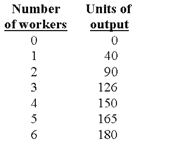
Problem on marginal returns
Select the right ans wer of the question. Refer to the following data. Diminishing marginal returns become evident with the addition of the: A) sixth worker B) fourth worker. C) third worker. D) second worker.
Not in between the total demands for loanable funds would be the demands of: (1) consumers for financial capital. (2) business firms for financial capital. (3) government for loanable funds to cover budget deficits. (4) consumers for mortgage funds. (
Can someone please help me in finding out the accurate answer from the following question. When an aluminum producer as well mined bauxite ore (employed in aluminum production) and manufactured beer cans, it will be: (i) The diagonal partnership. (ii) Vertically integ
Can someone help me in finding out the most precise answer from the given options. Securing financing for the economic capital for a corporation can’t be accomplished by: (i) Issuing common stock. (ii) Issuing the corporate bonds. (iii) Securing the majority of
The baseball manager, whose players decline to bunt occasionally, rather always swinging for the homeruns, faces a: (i) Second-mover drawback. (ii) Prisoner’s dilemma. (iii) Principal-agent problem. (iv) Grim strategy. Can so
When the government obliged a ceiling price of P0 on papayas, the market scarcity would correspond to line: (1) ab. (2) cd. (3) ac. (4) bd. (5) ae. Q : Monopolistic-Exploitation problem In In equilibrium for the price maker firm, the rate of monopolistic exploitation is the difference between: (i) P and MR. (ii) P and MC. (iii) Total revenue and net cost per unit of output. (iv) Output price and rate of monopsonistic exploitation. (v) VMP and MRP.
In equilibrium for the price maker firm, the rate of monopolistic exploitation is the difference between: (i) P and MR. (ii) P and MC. (iii) Total revenue and net cost per unit of output. (iv) Output price and rate of monopsonistic exploitation. (v) VMP and MRP.
In the above diagram, the elimination of discrimination is best represented by:
As per the equality standard of income distribution: (w) people should be paid according to their needs for income. (x) income should be distributed to resource owners. (y) justice requires national income to be divided equally. (z) people should be p
In adding up to monetary prices, the costs of buying and selling comprise: (1) Wage payments. (2) Monopoly gains. (3) Social advantages. (4) Transaction costs. (5) Pecuniary externalities. Please someone suggest me
An industry dominated by some consciously interdependent firms which control most of its output is an: (1) uncontestable market. (2) oligopoly. (3) illegal conspiracy. (4) unnatural monopoly. (5) entrepreneurial cartel. Can someone
18,76,764
1931336 Asked
3,689
Active Tutors
1460840
Questions Answered
Start Excelling in your courses, Ask an Expert and get answers for your homework and assignments!!