--%>

Problem on head loss

The pump illustrated in the figure adds 20 kW of power to the flowing water. The only vital loss is that which takes place across the filter at the inlet of the pump. Find out the head loss for this filter. Note that the gage pressure upstream of the filter is negative and the jet placed at the pump exit is free. Take α = 1.
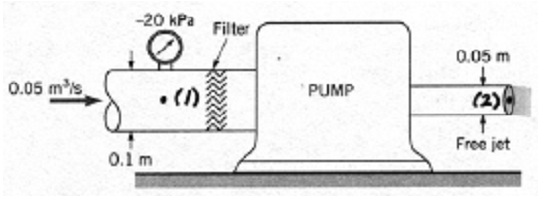
738_head loss.jpg

   Related Questions in Mechanical Engineering

  • Q : Unilateral and Bilateral Tolerance

    Explain difference between the Unilateral and Bilateral Tolerance?

  • Q : Problem related to pressure gauge Water

    Water flowing via the vertical pipe is illustrated below. Compute the required pipe diameter for the smaller pipe,‘d’,  given that the two pressure gauges read similar value.

    Q : Aim of an airspeed indicator in aircraft

    What is the main aim of an airspeed indicator in aircraft?

  • Q : Sources of energy what are different

    what are different alternate sources of energy

  • Q : What is cotter joint Explain what is

    Explain what is meant by the Cotter joint?

  • Q : How do you repair a hydraulic jack How

    How do you repair a hydraulic jack?

  • Q : Efficient use of waste heat and

    Efficient use of waste heat and renewable heat sources 1. Describe how you might recover heat from (a) a process exhaust gas stream (e.g. from an oven) and (b) a process warm water stream (e.

  • Q : Problem on discharge of water In the

    In the below system, d = 6 in., D = 12 in., Δz1 = 6 ft, and Δz2 = 12 ft. The discharge of water in the given system is 10 cfs. Is the machine a turbine or a pump ? Determine the pressures at points A and B? Neglect head losses. Suppos

  • Q : Solution A pump station has been

    A pump station has been designed to lift water out of a 6 metre deep pit (vented to atmosphere) via a centrifigual pump mounted at ground level. Liquid conditions 20OC Suction pipe work losses 2.0 metres NPSH safety factor 5.0 kPa Vapor pressure @ 20oC 0.25 metres (a) Calculat

  • Q : Problem on pressure rise of a water tank

    The water level in a tank is about 20 m above the ground. A hose is joined to the bottom of the tank, and the nozzle in the end of the hose is pointed to straight up. The tank is at sea level, and the water surface is open to the environment. In the line leading from