--%>

Problem on equilibrium composition

The catalytic dehydrogenation of 1-butene to 1,3-butadiene,

C4H8(g) = C4H6(g)+H2(g)

is carried out at 900 K and 1 atm.

a) Show that C4H8, C4H6 and H2 can be considered ideal gases at 900 K and 1 atm.

b) If the inlet stream to the reactor contains 10 mol of steam per mol of butene (steam is used as a diluent gas), determine the extent of reaction at equilibrium.

c) Determine the extent of reaction in the absence of steam.

d) How would an increase in temperature or pressure affect the equilibrium composition?

Data:
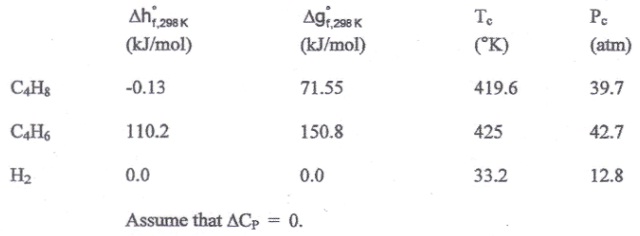
2422_catalytic.jpg

   Related Questions in Chemistry

  • Q : How haloalkanes are prepared from

    Alkyl halides can be prepared from alkanes through substitution and from alkenes through addition of halogen acids or through allylic substitution.    From alkanesWhen alkanes are treated with halogens, chlo

  • Q : Net charge of a non-ionized atom

    Describe the net charge of a non-ionized atom?

  • Q : Molar concentration of hydrogen 20 g of

    20 g of hydrogen is present in 5 litre of vessel. Determine he molar concentration of hydrogen: (a) 4  (b) 1 (c) 3 (d) 2 Choose the right answer from above.

  • Q : Explain the catalyst definition and

    Catalyst is a substance which accelerates the rate of a chemical reaction without undergoing any change in its chemical composition or mass during the reaction. The phenomenon of increasing the rate of a reaction with the help of a catalyst is known as catalysis.

  • Q : Reason for medications contain hcl What

    What is the reason behind this that some medications contain hcl?

  • Q : What are ion selective electrodes? Ion

    Ion Selective Electrodes An ion selective membrane can be used to form an electrochemical cell whose emf depends on the concentration of that ion. Before we proceed to an important application of emf measurements, brie

  • Q : Molarity in Nacl The molarity of 0.006

    The molarity of 0.006 mole of NaCl in 100 solutions will be: (i) 0.6 (ii) 0.06 (iii) 0.006 (iv) 0.066 (v) None of theseChoose the right answer from above.Answer: The right answer is (ii) M = n/ v(

  • Q : Theory of three dimensional motion

    Partition function; that the translational energy of 1 mol of molecules is 3/2 RT will come as no surprise. But the calculation of this result further illustrates the use of quantized states and the partition function to obtain macroscopic properties. The partition fu

  • Q : How alkyl group reactions takes place?

    Halogenations: ethers react with chlorine and bromine to give substitution products. The extent of halogenations depends upon the conditions of reacti

  • Q : Chem Explain how dissolving the Group

    Explain how dissolving the Group IV carbonate precipitate with 6M CH3COOH, followed by the addition of extra acetic acid.