--%>

Problem on bubble point

The following mixture of hydrocarbons is obtained as one stream in a petroleum refinery.
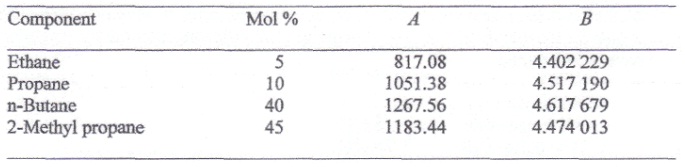
449_dew point.jpg

The parameters A and B in this table are the constants in the equation

log10 Pvap = (-A/T) + B

Where Pvap is the vapor pressure in bar and T is the temperature in K. These paraffinic hydrocarbons form an ideal mixture.

a. Compute the bubble point of me mixture at 5 bar.

b. Compute the dew point of the mixture at 5 bar.

c. Find the amounts and compositions of the vapor and liquid phases that would result if this mixture were isothermally flash-vaporized at 30°C from a high pressure to 5 bar.

   Related Questions in Chemistry

  • Q : What are methods of phenol preparation

    Phenol was initially obtained by fractional distillation of coal

  • Q : Various cons of eating the organic foods

    Describe the various cons of eating the organic foods? Briefly illustrate it.

  • Q : Oxoacids of halogens Why oxidising

    Why oxidising character of oxoacids of halogens decreases as oxidation number increases?

  • Q : Mcq Give me answer of this question.

    Give me answer of this question. The normality of 10% (weight/volume) acetic acid is: (a)1 N (b)10 N (c)1.7 N (d) 0.83 N

  • Q : Molarity Give me answer of this

    Give me answer of this question. If 20ml of 0.4N, NaoH solution completely neutralises 40ml of a dibasic acid. The molarity of the acid solution is:(a) 0.1M (b) 0.2M (c)0.3M (d)0.4M

  • Q : Neutralization of sodium hydroxide How

    How much of NaOH is needed to neutralise 1500 cm3 of 0.1N HCl (given = At. wt. of Na =23): (i) 4 g  (ii) 6 g (iii) 40 g  (iv) 60 g

  • Q : Illustrations of the reversible reaction

    What are the various illustrations of the reversible reaction? Explain briefly?

  • Q : Electrochemistry ( electrolysis of

    1. Define Faraday's first law of electrolysis 2. define Faraday's second law of electrolysis

  • Q : Cations Chromium(III) hydroxide is

    Chromium(III) hydroxide is highly insoluble in distilled water but dissolves readily in either acidic or basic solution. Briefly explain why the compound can dissolve in acidic or in basic but not in neutral solution. Write appropriate equations to support your answer

  • Q : What are electromotive force in

    The main objective of this particular aspect of Physical Chemistry is to examine the relation between free energies and the mechanical energy of electromotive force of electrochemical cells. The ionic components of aqueous solutions can be treated on the basis of the