--%>

Problem of Nash Equilibrium

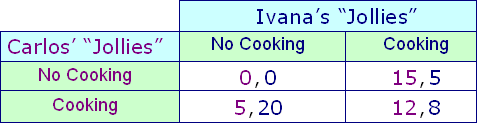
Carlos and Ivana are room-mates and friends. Carlos and Ivana eat together despite who cooks on a given night. Within this payoff matrix, Nash equilibrium could never be obtained in that: (w) neither Carlos nor Ivana cook, nor do they eat. (x) Carlos alone cooks for both of them. (y) Ivana alone cooks for both of them. (z) Carlos and Ivana share the cooking chores, and after that they eat together.
2054_Problem on Nash Equilibrium.png

Can someone explain/help me with best solution about problem of Economics...

   Related Questions in Microeconomics

  • Q : Question related to Monopoly Refer to

    Refer to the following figure . Assume the graphs represent the demand for use of a local golf course for which there is no significant competition (it has a local monopoly); P indicates the price of a round of golf; Q is the quantity of rounds "sold" each day. If th

  • Q : Multimarket Monopoly A monopolist

    A monopolist operates in two separated markets. The inverse demand functions ofthose markets are given by      and      where   arethe quantities supplied to these markets, respectively. The total cost function facedby the monopolist is &nbs

  • Q : What is an Indifference curve

    Indifference curve: It is the combination of two goods that provides consumer similar level of satisfaction.

  • Q : Quantity demanded of good What cause do

    What cause do heterodox economists employ to argue that the quantity demanded of good is a not a function of its price but of the family’s (consumer’s) income? And also discuss, For heterodox economists, household choice is not regarding maximizing utility

  • Q : Problem on Labor History-Yellow Dog

    The yellow dog contracts are now proscribed, however in the early 20th century such agreements among employers: (i) Not to purchase intermediate goods made by unionized labor hindered labor market transformations. (ii) And workers stating that the workers would not jo

  • Q : What is the equilibrium price and

      Objectives: This assessment item relates to the course learning outcomes 1, 2 and 3 as listed in Part A. Question 1 (22 marks) (a) Consider the market represented by the schedule in the table below. (5 marks) Price Quantity demanded Quantity

  • Q : Charge price similar to marginal cost

    When a profit-maximizing monopolist who does not price discriminate charges a price equal to its marginal cost, this will: (w) minimize average cost and generate zero economic profit. (x) minimize average cost and gen

  • Q : Total revenue in profit-maximizing

    Total revenue (i.e., TR=PQ) for such profit-maximizing competitive firm equals area as: (a) 0P1gq5. (b) 0P1dq4. (c) 0P2cq3. (d) P2

  • Q : Market adjustments due to raised

    Normal 0 false false

  • Q : Problem on Blacklisting The

    The Blacklisting was once common however now illegal in the labor market practice of: (i) Boycotting the products of firms whose workers are on strike. (ii) Forcing the workers to sign agreements not to join the unions. (iii) Paying the union officers to systematize u