--%>

Problem based on production possibilities curve

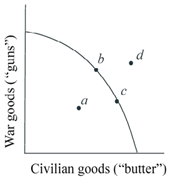
Refer to the given production possibilities curve and give  answer of following question . At the onset of the Second World War the Soviet Union was already at full employment. Its economic adjustment from peacetime to wartime can best be described by the movement from point: A) c to point b. B) b to point c. C) a to point b. D) c to point d.
928_6.png

Some one help me in getting out from above question

   Related Questions in Microeconomics

  • Q : Determine profit maximizing A

    A monopolist has an inverse demand curve given by p(y) = 12 - y and a cost curve given by c(y) = y2. (a) What will be its profi t maximizing level of output?

  • Q : Shift in demand curve Describe the

    Describe the differences between shifts in demand and movements along the demand curve. What are the main factors which can shift the demand curve? Explain why they cause the demand curve to shift. Use examples and draw graphs to supp

  • Q : Quantity Equilibrium I have the

    I have the quantity functions of demand and supply for two different goods, and I have to find the equilibrium of both the goods. Would I make all four functions equal to each other to find the equilibrium for the two goods? Or am I supposed to do something else?

  • Q : Requirements for pure competition The

    The needs for pure competition are most intimately met by the market for: (i) domestic (American) steel. (ii) comic books. (iii) sugar-coated cereal within your local grocery store. (iv) stocks and bonds traded on Wall Street after they have been issu

  • Q : Labor Force Participation Rates The

    The percentage of a specific population who is either unemployed or employed or is termed as the: (i) Labor force participation rate. (ii) Work-force proportion. (iii) Income-leisure loss curve. (iv) Substitution effect dominance rate. (v) Labor supply.

  • Q : Problem on cost curve The following

    The following diagram illustrates the short-run average total cost curves for five different plant sizes of any firm. The shape of each curve reflects: 1) increasing returns, followed by diminishing returns. 2) economies of scale, followed by diseconomies of scale. 3)

  • Q : Concentration ratio Explain the concept

    Explain the concept of a concentration ratio.  Is the concentration ratio in a monopolistically competitive industry likely to be higher than for a perfectly competitive industry

  • Q : Effective price discrimination

    Effective price discrimination does NOT need a firm to: (w) segment the market into groups along with various demand elasticities.  (x) be a monopoly. (y) prevent trading among customers who are charged different prices. (z) possess some market p

  • Q : Occurrence of Adverse Selection When an

    When an NFL football team obscures information regarding damage to a former all-pro linebacker’s knees prior to trading him to the other team, the team which receives that player loses since of: (1) Immoral hazard. (2) Malfeasance. (3) Perverse selection. (4) Ad

  • Q : Rent controls fix rent in equilibrium

    Rent controls which fix rents below equilibrium will NOT: (w) maintain monetary rents down. (x) create shortages of rental housing. (y) stimulate non-market allocations of rental housing. (z) maintain the opportunity costs of housing down.