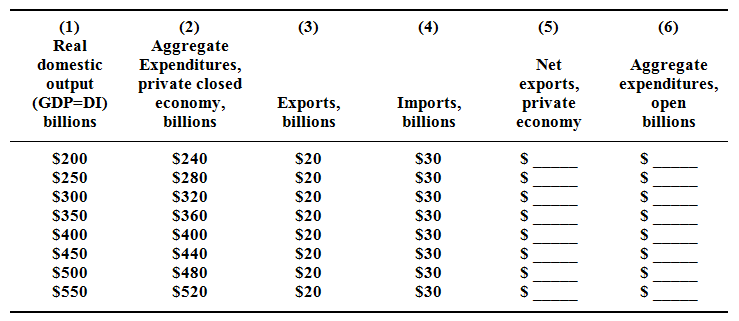
Private closed economy based question
The data of columns 1 and 2 of the below table are for a private closed economy. Given the original $20 billion level of exports, determine the equilibrium GDP if imports were $10 billion greater at each level of GDP?
Expert
Imports = $40 billion: In the private open economy aggregate expenditures would fall by $10 billion at each GDP level and the new equilibrium GDP would be $300 billion.
Frauds in banks: In today’s world all the financial institutions face a major problem of security in banking operations. Today it is a challenge in front of ever bank to secure its functioning and avoid the fraudulent practices in their banks. I
How do opportunity costs influence the capital budgeting decision-making procedure? Opportunity costs reflect the foregone benefits of alternative not selected when a capital budgeting project is chosen. Any decrease in the cash flows of the fi
Normal 0 false false
Unscheduled Reimbursements: The Reimbursements collected by an agency which were not budgeted and are accounted for by an individual reimbursement class of an appropriation. To expend unscheduled reimbursements, the budget revision sh
Cost-of-Living Adjustments (COLA): Increases offered in state-funded programs which comprise periodic adjustments predetermined in state law (statutory, like K-12 education apportionments), or established at optional levels (that is discretionary) by
Financial Planning: It is a comprehensive assessment of an investor's present and future financial state by employing presently known variables to forecast future cash flows, asset values and the withdrawal plans.
Veto: It is the Governor's Constitutional authority to reduce or remove one or more items of appropriation while accepting other parts of a bill.
Under what conditions is a warrant's value high? Describe. A warrant's value would be great when the stock price, time to expiration, and/or expected stock price volatility is great.
18,76,764
1942865 Asked
3,689
Active Tutors
1417710
Questions Answered
Start Excelling in your courses, Ask an Expert and get answers for your homework and assignments!!