--%>

Prices and costs in monopoly market

When this monopoly generates Q units: (1) P > MC. (2) MR = MC. (3) total revenue total cost is maximized. (4) MSB > MSC. (5) All of the above.
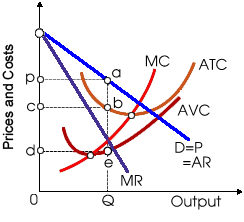
1826_Market Power and Price Discrimination.png

I need a good answer on the topic of Economics problems. Please give me your suggestion for the same by using above options.

   Related Questions in Microeconomics

  • Q : Produce output by zero marginal reveune

    When LoCalLoCarbo, the favorite corporation of fad dieters,in that case produces output q* [that where is marginal revenue is zero] as: (1) LoCalLoCarbo’s total revenue is at its highest possible level. (2) expanding output to q4 would cause tot

  • Q : Marginal revenue by maximizes total

    A monopolist maximizes its total revenue where marginal revenue: (1) is flat. (2) is rising. (3) is zero. (4) equals marginal cost. (5) is negative. Can someone explain/help me with best solution a

  • Q : Exploitation and Competitive Markets

    The removal of exploitation of labor (or wage payments beneath the value to the society of each and every individual worker’s productive contribution) is automatic when business decision makers: (1) Should set wages via collective bargaining agreements by labor

  • Q : Unitarily elastic demand by fixing all

    A monopolist who does not price discriminate, that is: (w) cannot maximize profit by producing where demand is unitarily elastic. (x) will maximize profit where demand is unitarily elastic when all costs are fixed. (y) will maximize profit where deman

  • Q : Monopolistic Exploitation problem Can

    Can someone help me in finding out the right answer from the given options. When a firm hires labor to a point where VMPL > MRPL = MFCL = w, then the (1) Firm consists of monopsony power. (2) Employees of firm are experiencing t

  • Q : Define saving function Saving function

    Saving function: The relationship among saving and income is termed as saving function.

  • Q : Critics of the simple limit pricing

    Critics of the straightforward limit pricing strategy argue about that: (w) sunk costs are not important in deterring entry. (x) for limit pricing to work, there should be a credible threat to keep old output levels. (y) this is rational to expect the

  • Q : Demand and supply An increase in

    An increase in consumer desire for strawberries is most likely to: A) increase the number of strawberry pickers needed by farmers. B) reduce the supply of strawberries. C) reduce the number of people willing to pick strawberries. D) reduce the need for strawberry pic

  • Q : Limit pricing model of strategic

    The assumption essential for the result of the limit pricing model of strategic behavior is: (a) entrant firms price at marginal cost. (b) entry and exit is relatively costless. (c) the incumbent firms will maintain old output levels after entry of a

  • Q : Most desperate market participants of

    Tax burdens on transactions are probably to be disproportionately borne through the relatively as “most desperate” market participants those, who are: (1) sellers when the market supply curve is relatively