--%>

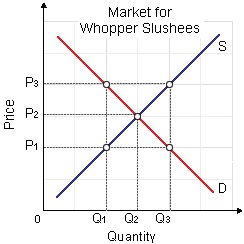
Price floor for Whopper Slushees

The government price floor for Whopper Slushees at P3 would result a: (i) shortage of Q1 – Q3. (ii) Excess of Q3 - Q1. (iii) Supply price of P1. (iv) Quantity demanded of Q2. (v) Demand price of P2.
812_4.jpg

Can someone help me in getting through this problem

   Related Questions in Microeconomics

  • Q : Decreasing marginal returns and

    What is the difference between decreasing marginal returns and negative marginal returns?

  • Q : Competitive resource markets and low

    When resource markets are competitive and transaction costs are low, in that case landowners: (1) pass forward completely any land tax. (2) can drive up the rental rate of land by changing its supply. (3) bear the full burden of any t

  • Q : Substitutes and Complements The

    The increase in the price of a good generally also rises the: (i) Demands for its substitutes. (ii) Supply of its complements. (iii) Purchasing power of the consumer incomes. (iv) Demand for its complements. Can someone please help

  • Q : Law of Demand in respect to relative

    I have a problem in economics on Law of Demand in respect to relative price. Please help me in the following question. The law of demand defines that as: (1) Absolute prices rise, quantity demanded raises. (2) Relative prices raise, quantity demanded

  • Q : Define Ex-ante aggregate demand Define

    Define Ex-ante aggregate demand: This is planned or the desired aggregate demand.

  • Q : Effective price discrimination

    Effective price discrimination does NOT need a firm to: (w) segment the market into groups along with various demand elasticities.  (x) be a monopoly. (y) prevent trading among customers who are charged different prices. (z) possess some market p

  • Q : Vigorous competition by firms in an

    Allocating scarce resources hence they are put to the uses which best satisfy consumer wants is facilitated through: (w) highly bureaucratic, centralized decision making. (x) tax breaks for wealthy people which “trickle down” to consumers. (y) vigorous com

  • Q : Illustration of Conglomerates I have a

    I have a problem in economics on Illustration of Conglomerates. Please help me in the following question. Prudential Insurance owns big farms in addition to its insurance operations, and is an illustration of: (1) Conglomerate. (2) Insurance fraud. (3) Monopoly. (4) H

  • Q : Joint Profit Maximization Joint profit

    Joint profit maximization is least compatible along with the behavior of: (w) General Motors’ division in Chevrolet, Cadillac, Hummer, Delco Remy and Frigidaire, etc. (x) a successful cartel as like OPEC. (y) a collusive agreement leading to sha

  • Q : Needs by marginal revenue equals to

    A monopolist produces where marginal revenue [MR] equals marginal costs [MC] when it needs to maximize: (i) total revenue. (ii) consumer surplus. (iii) profits. (iv) total revenue, producer surplus and profits. (v) job security.