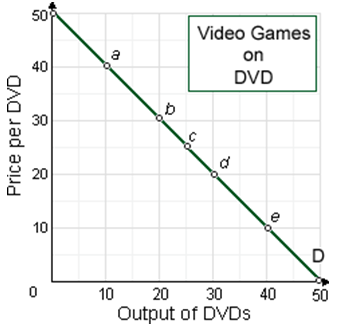
Price elasticity of demands for moving points
Moving from point d to point e beside demand curve D, the price elasticity of demands of DVDs of video games at equal: (a) 0.8. (b) one. (c) 1.10. (d) 1.25. (e) 2.50 How can I solve my Economics problem? Please suggest me the correct answer.
Moving from point d to point e beside demand curve D, the price elasticity of demands of DVDs of video games at equal: (a) 0.8. (b) one. (c) 1.10. (d) 1.25. (e) 2.50
How can I solve my Economics problem? Please suggest me the correct answer.
When the interest rate is 5% and a financial investment produces annual payments of price $50,000, in that case the present value of this asset is: (w) $1,000,000. (x) $5,000,000. (y) $500,000. (z) $10,000,000. Q : Floating exchange rates Provide Provide solution of this question. In saying that the present system of floating exchange rates is managed we mean that: A) countries which allow their exchange rate to move freely will lose their borrowing privileges with the IMF. B) the value of any IMF member
Provide solution of this question. In saying that the present system of floating exchange rates is managed we mean that: A) countries which allow their exchange rate to move freely will lose their borrowing privileges with the IMF. B) the value of any IMF member
Can someone help me in finding out the right answer from the given options. According to the law of diminishing marginal utility, the longer that Chris and Lee kiss: (i) The less invested each will be in enduring this relationship. (ii) The closer they are to arriving
For environmental quality the demand is income elastic for most people, that implies that prosperity and higher incomes tend to: (w) increase people’s concerns about air, water, and noise pollution. (x) reduce efforts to solve pollution problems
In which market form, the products are distinguished. Answer: In Monopolistic competition
What do you mean by the term privatization?
Can someone help me in finding out the most precise answer from the given options. Securing financing for the economic capital for a corporation can’t be accomplished by: (i) Issuing common stock. (ii) Issuing the corporate bonds. (iii) Securing the majority of
A monopoly is a single: (w) seller of differentiated products. (x) producer of a good for that there are no close substitutes. (y) producer of a good for that there are several substitutes. (z) buyer of products into the market. Q : Union Shop Agreements The union shop The union shop agreement needs that the worker: (1) Join the labor union prior to beginning to work. (2) Pay union dues even when selecting not to join union. (3) Join the union soon subsequent to being hired. (4) Freely select to join or not join union.
The union shop agreement needs that the worker: (1) Join the labor union prior to beginning to work. (2) Pay union dues even when selecting not to join union. (3) Join the union soon subsequent to being hired. (4) Freely select to join or not join union.
An IOU which pays a fixed amount of interest every year, without a maturity date, that is a: (w) T-bill. (x) fiduciary. (y) Series E bond. (z) perpetuity. I need a good answer on the topic of Economics
18,76,764
1938851 Asked
3,689
Active Tutors
1415083
Questions Answered
Start Excelling in your courses, Ask an Expert and get answers for your homework and assignments!!