--%>

Price elasticity of demand for pizza

Since the price drops/falls from $8 to 1 all along this demand curve, the price elasticity of demand for pizza: (1) increases towards infinity. (2) Drops/Falls towards zero. (3) Increases, then drop/falls. (4) Always equivalents 1 and demand is unitarily elastic.
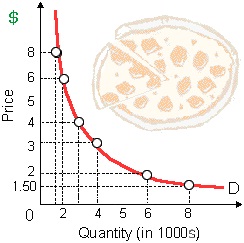
1943_9.jpg

Can someone help me in getting through this problem.

   Related Questions in Microeconomics

  • Q : Competitive equilibrium in competitive

    I have a problem in economics on Competitive equilibrium in competitive labor markets. Please help me in the following question. The Competitive equilibrium in competitive labor markets need: (1) P = MR = AVC. (2) VMP - P is maximized. (3) MPP = P. (4

  • Q : Price cross elasticity of demand among

    A 2 percent price cut for doodads causes gizmo sales to fall by 3 percent. The price cross elasticity of demand among these goods is approximately _____ and such goods are _____. (w)  2/3, substitutes. (x) 1.5, substitutes. (y) 2/3, complements.

  • Q : Why production possibilities curve

    What is the reason that production possibilities curve concave? Elucidate.

  • Q : Monetary liability All currency issued

    All currency issued by central bank is its monetary liability. Explain how? Answer: The Central Bank is grateful to back the currency with assets of equivalent valu

  • Q : Law of Diminishing marginal utility

    Describe the Law of Diminishing marginal utility? Answer: Law of Diminishing marginal utility: As a consumer goes on consuming more and more units of a commodity th

  • Q : Monopolistic competition in long run

    When this firm initially had important market power along with potential long-run economic profit, a likely cause of the firm finally being in a stable equilibrium of an $18 price and output of 5,000 units every day would be:  (1

  • Q : Elasticity and Revenue At the point of

    At the point of unit elasticity beside the demand curve then a firm faces: (w) profits are always maximized. (x) total revenue is certainly at a maximum. (y) total costs are minimized. (z) All of the above. I need

  • Q : Real interest rate in saving and

    When the real interest rate : (w) is low, there are greater incentives to borrow and fewer incentives to lend. (x) is low, there are greater incentives to lend and fewer incentives to borrow. (y) equals the nominal interest rate + the expected rate of

  • Q : Effective price discrimination

    Effective price discrimination does NOT need a firm to: (w) segment the market into groups along with various demand elasticities.  (x) be a monopoly. (y) prevent trading among customers who are charged different prices. (z) possess some market p

  • Q : Problem relating to current demands for

    The people who anticipate prices to increase soon will tend to rise their: (i) Current demands for the durable goods. (ii) Waiting time prior to buying. (iii) Saving as a result they can afford higher prices. (iv) Current supplies.