--%>

Price elasticity for quantities and prices

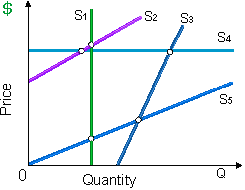
Suppose that all these curves are infinitely long straight lines. There supply curve which is relatively (although not perfectly) price elastic for all quantities and prices is: (1) supply curve S1. (2) supply curve S2. (3) supply curve S3. (4) supply curve S4. (5) supply curve S5.
1069_Price Elasticity of Supply1.png

Hey friends please give your opinion for the problem of Economics that is given above.

   Related Questions in Microeconomics

  • Q : Levels of the Poverty Line In 2005

    In 2005 year, the proportion of people along with family incomes below the official poverty line into the United States was around: (w) one in eight. (x) one in ten. (y) two in twenty five. (z) one in twenty.

    Q : Consuming equal successive units of good

    The idea that additional satisfaction ultimately declines from consuming equivalent successive units of any good is the law of: (1) Consumer deficits. (2) Equivalent marginal utilities per dollar. (3) Diminishing marginal utility. (4) Veblen’s inequality. (5) Co

  • Q : Problem on Monopolistic Competition

    When fifty fast-food restaurants belonging to fourteen various chains are strung along an eight mile stretch of highway, it is an illustration of: (1) a primitive cartel. (2) pure competition. (3) monopolistic competition. (4) an oligopoly.

    Q : Total increase in national income In an

    In an economy the MPC is 0.75. Investment expenses in the economy raise by Rs.75 crore. Compute total increase in national income.

  • Q : Nondiscriminating monopolists in short

    Within short run equilibrium, there nondiscriminating monopolists will: (w) charge prices greater than their marginal costs. (x) produce outputs which maximize social welfare. (y) produce where their total revenues are maximized. (z)

  • Q : Costs of rate of return The rate of

    The rate of return for an asset which costs $1,500 today and pays $1,800 a year from now is: (1) 5 percent. (2) 10 percent. (3) 15 percent. (4) 17.5 percent. (5) 20 percent. Please choose the right answer from abov

  • Q : Surviving for maximum profits in

    Supposing that the competitive firms should seek the maximum profits to survive signifies that: (1) Firm do not make trial-and-error decisions. (2) Each and every firm always seeks the maximum gain and nothing else. (3) Competition is very profitable.

  • Q : Practicing joint profit maximization A

    A cartel is: (w) any large multinational corporation like OPEC. (x) a group of oligopolists practicing conscious parallelism of action. (y) a group of firms which practices joint profit maximization. (z) a multinational firm along with government subs

  • Q : Ceteris Paribus assumption The ceteris

    The ceteris paribus (all as well constant) assumption is most obviously implicit in the statement of a tailor who states that, “We will vend more suits in the month of May of 2008: (i) Than we sold in the month of May 2003. (ii) Than we sold in

  • Q : Illustrate normative statement In

    In economics illustrate normative statement?