--%>

Plans of savers and investors

This capital market is within a closed private economy. Primary plans of savers and investors are demonstrated as curves S0 and I0. There Market equilibrium will exist at: (1) point a. (2) point b. (3) point c. (4) point d. (5) point e.
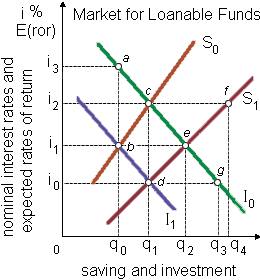
257_Problem on Loanable Funds.png

Hey friends please give your opinion for the problem of Economics that is given above.

   Related Questions in Microeconomics

  • Q : Demand curve for physical economic

    The demand curve for physical economic capital based most directly onto the: (w) extent of previous automation. (x) willingness of savers to create investment funds available. (y) marginal productivity of capital and the price of its output. (z) suppl

  • Q : Define Inferior good Inferior good : It

    Inferior good: It is a good for which, other things equivalent, a rise in income leads to a reduction in demand.

  • Q : Asset demand Select the right answer of

    Select the right answer of the question. The asset demand for money: A) is unrelated to both the interest rate and the level of GDP. B) varies inversely with the rate of interest. C) varies inversely with the level of real GDP. D) varies directly with the level of nom

  • Q : Equilibrium for a price maker firm I

    I have a problem in economics on Equilibrium for a price maker firm. Please help me in the following question. In equilibrium, for a price maker firm, the charge of monopolistic exploitation is any difference among: (1) P and MR. (2) P and MC. (3) VMP

  • Q : Influences of Ceteris Paribus The Latin

    The Latin phrase applies to the idea which all other effects on some dependent variable are to be supposed constant if examining the effect of changing a single independent variable is as: (1) Fiat justitia, ruat coelum. (2) Platea unum. (3) Unum paribus. (4) Ceteris

  • Q : Expectations of short run effect Most

    Most of the consumers and investors have learned via experience that ‘new’ high-tech equipment becomes outdated quickly, and that prices drop by roughly half annually. They adjust by delaying purchases, waiting for estimated higher quality and lower prices

  • Q : Increase total revenue at a diminishing

    When a monopolist increases output along with elastic demand, then total revenue: (w) increases at a constant rate. (x) increases at an increasing rate. (y) increases at a diminishing rate. (z) All of the above are possible.

  • Q : Technological advances in natural

    Natural barriers to entry may be overcome across time from: (w) cut-throat competition. (x) elimination of patent laws. (y) technological advances. (z) rigorous enforcement of antitrust laws. How can I solve my

  • Q : Inefficiency of market equilibrium When

    When firms have market power although do not price discriminate perfectly, in that case the market equilibrium will be inefficient since: (w) P = AC = MC. (x) total revenue equals total costs [TR = TC]. (y) MSB = P > MC = MSC. (z)

  • Q : Problem Regarding to Contestable Markets

    Even though the concentration ratio for an oligopoly is close to hundred, firms may operate rather efficiently when the market: (1) price conforms to a limit pricing model. (2) is contestable since entry and exit are easy. (3) demand curve is unitaril