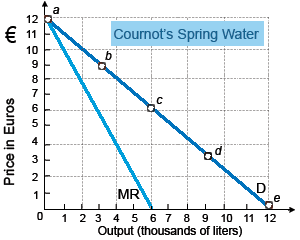
Perfectly price inelastic demand
For Cournot’s Spring Water the demand is perfectly price inelastic at: (i) point a. (ii) point b. (iii) point c (iv) point d. (v) point e. Hey friends please give your opinion for the problem of Economics that is given above.
For Cournot’s Spring Water the demand is perfectly price inelastic at: (i) point a. (ii) point b. (iii) point c (iv) point d. (v) point e.
Hey friends please give your opinion for the problem of Economics that is given above.
Within increasing-cost industries average there are: (w) production costs fall as output increases. (x) production costs rise as the number of firms in the industry grows. (y) production costs rise when the number of firms into the industry falls. (z)
When it is feasible for total revenue to exceed variable costs, in that case a monopolist which does not price discriminate maximizes profits or minimizes losses from producing the output where marginal revenu
When this firm is typical into this purely-competitive of constant-cost industry, as in demonstrated figure in long-run equilibrium for cranberries will be attained at a market price of: (i) P1. (ii) P2. (iii) P<
Can someone please help me in finding out the accurate answer from the following question. The elasticity of demand for the labor tends to rise as there are increases in the: (i) Amount of capital utilized in a production procedure. (ii) Rate of automation in industry
Contestable markets and purely competitive markets share the feature of: (w) collusive behavior of huge firms. (x) freedom of entry and exit into the long run. (y) widespread product differentiation. (z) persistent economic profits. Q : Problem relating to Changes in Demand Airlines considerably decreased the number of flights accessible in the year 2005, as compared to flight availability during the year 2000. Passenger mileage was fall. Economists would be least possible to ascribe the decline in airline ticket sales throughout the ear
Airlines considerably decreased the number of flights accessible in the year 2005, as compared to flight availability during the year 2000. Passenger mileage was fall. Economists would be least possible to ascribe the decline in airline ticket sales throughout the ear
To form and effectively keep a cartel over time needs that the: (w) bulk of output be produced and sold by a minute number of cartel members. (x) product be relatively heterogeneous. (y) demand for the product be highly elastic. (z) government totall
Throughout periods while the activities of speculators raise the volatility and average level of prices, classical speculators are most probable to: (1) gain profits by buying high and selling low. (2) reduces the risks to other firms of doing busines
Along with freedom of entry in a monopolistically competitive market, in long run equilibrium is reached along with firms: (w) earning zero economic profit. (x) producing where price equals marginal cost. (y) producing their most efficient output. (z)
Compared to other relatively prosperous developed nations, the United States: (w) has greater inequality in the distribution of its wealth and national income. (x) enjoys the lowest cost medical care and the best average public health. (y) has been the most aggressive
18,76,764
1947832 Asked
3,689
Active Tutors
1451464
Questions Answered
Start Excelling in your courses, Ask an Expert and get answers for your homework and assignments!!