--%>

Perfectly price elastic demand

For Cournot’s Spring Water the demand is perfectly price elastic at:  (i) point a. (ii) point b. (iii) point c (iv) point d. (v) point e.
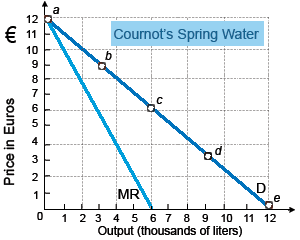
984_Elasticity and Total Revenue.png

I need a good answer on the topic of Economics problems. Please give me your suggestion for the same by using above options.

   Related Questions in Microeconomics

  • Q : Monopolistic Exploitation problem Can

    Can someone help me in finding out the right answer from the given options. When a firm hires labor to a point where VMPL > MRPL = MFCL = w, then the (1) Firm consists of monopsony power. (2) Employees of firm are experiencing t

  • Q : Transitivity Please provide me answer

    Please provide me answer of this question. What will be the implications for consumer's preferences and her indifference curves if the axiom of transitivity does not hold?

  • Q : Price increment in elasticity A price

    A price hike $4 to $5 per slice of pizza because of total revenue to: (w) fall. (x) remain constant. (y) rise. (z) this is not possible to tell from such data.

    Q : Where is the price elasticity of supply

    The price elasticity of supply as in below demonstrated figure is unitary within: (w) Panel A. (x) Panel B. (y) Panel C. (z) Panel D.

    Q : Company Unions-tools for managers Can

    Can someone please help me in finding out the accurate answer from the following question. Unions which act primarily as the tools for managers of a firm are termed as: (1) Managerial unions. (2) Company unions. (3) Wildcat unions. (4) Union-busters.

  • Q : Determine income elasticity of demand

    An income elasticity of demand for mass transit of 0.6 implies that the demand for mass transit is/will: (1) a necessity. (2) a luxury. (3) rise at a slower rate than income. (4) fall when income rises. How can I s

  • Q : Outcome of a purely competitive market

    When cost conditions are otherwise identical, compared to the outcome of a purely competitive market, in that case a monopolist: (w) produces less and charges more. (x) maximizes total profits whenever possible. (y) confronts a demand curve where P =

  • Q : Problem on demand for Inferior Goods I

    I have a problem in economics on demand for Inferior Goods. Please help me in the following question. When income rises, demands for: (1) Substitute goods reduce. (2) Inferior goods reduction. (3) Normal goods reduction. (4) Complementary goods rise.<

  • Q : Horizontal summation of individual

    The market demand curves for most of the goods are as: (i) Cross-multiplied products of the individual demand curves. (ii) Insignificant for most of the analytical aims. (iii) The horizontal summation of the individual demand curves. (iv) Irrelevant for business decis

  • Q : Monopolistic Exploitation Can someone

    Can someone help me in finding out the right answer from the given options. In the equilibrium for a price maker firm, the rate of monopolistic exploitation is any difference among: (i) P and MR. (ii) P and MC. (iii) VMP and MRP. (iv) Output price and rate of monopson