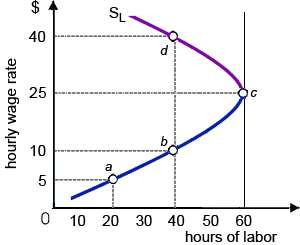
Perfectly inelastic labor-supply
This supply of labor of worker is perfectly inelastic at point: (w) point a. (x) point b. (y) point c. (z) point d. Can someone explain/help me with best solution about problem of Economics...
This supply of labor of worker is perfectly inelastic at point: (w) point a. (x) point b. (y) point c. (z) point d.
Can someone explain/help me with best solution about problem of Economics...
Illustrates the terms total cost, average cost and also marginal cost?
Economic rent shows part of the payment for the utilization of: (w) landowners’ labor and capital to keep their land. (x) landowners’ buildings and equipment. (y) resources for that supplies are less than perfectly elastic. (z) any piece o
States the functions and responsibilities of managerial economist?
A purely competitive resource market shows that an individual firm faces a resource supply curve which is: (w) perfectly inelastic. (x) perfectly elastic. (y) downward sloping. (z) backward bending. Q : Occurrence of General Training General General training occurs while a: (w) secretary learns a new office procedure. (x) handyman learns to drive a semi-truck. (y) messenger learns the company’s in-house mail route. (z) navy recruit learns how to repair a guided missile.
General training occurs while a: (w) secretary learns a new office procedure. (x) handyman learns to drive a semi-truck. (y) messenger learns the company’s in-house mail route. (z) navy recruit learns how to repair a guided missile.
Competitive equilibria in competitive labor markets need: (w) P = MR = AVC. (x) VMP - P is maximized. (y) VMP = MRP = MFC = w. (z) output is at a break-even level. (q) MPP = P. Can anybody suggest me the proper exp
Explain the Geometric Method of Measurement of Elasticity.
Concavity (or bowed-out shapes) in production possibilities frontiers is described least fine by: (i) The law of diminishing returns. (ii) Resources being unevenly suited for various forms of production. (iii) Rising opportunity costs. (iv) Non-neutra
Explain the accounting cost concept in brief.
For a purely competitive firm operating within a competitive labor market as: (1) the marginal resource cost of labor exceeds the wage rate. (2) the supply of labor is perfectly inelastic. (3) total labor costs are independent of the
18,76,764
1950541 Asked
3,689
Active Tutors
1422556
Questions Answered
Start Excelling in your courses, Ask an Expert and get answers for your homework and assignments!!