--%>

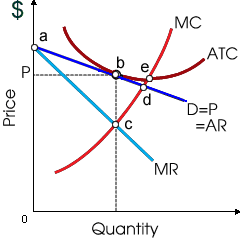
Output produces by monopolistic competitor

This monopolistic competitor generates Q0 output where is: (1) MR = MC. (2) MSB > MSC. (3) average cost is not minimized. (4) P = ATC. (5) All of the above.
1752_problem on Monopolistic Competition.png

Can anybody suggest me the proper explanation for given problem regarding Economics generally?

   Related Questions in Microeconomics

  • Q : Describe price elasticity of demand

    Price elasticity of demand: The Price elasticity of demand refers to the degree of responsiveness of the quantity demanded to modifications in price. Ed = (ΔQ/Δ P) x (P/Q)

  • Q : Nominal Interest Rates Nominal interest

    Nominal interest rates are: (w) always identical to real interest rates. (x) the percentage of monetary premiums paid per time era for the use of money. (y) determined by the size of economic rents. (z) the percentage of purchasing power transferred b

  • Q : Distribution of income in a purely

    For a specified distribution of income within a purely competitive economy, marginal social benefit will the same marginal social cost unless: (w) “hit and run” entrepreneurs prosper. (x) economic profits

  • Q : Define progressive in taxes as

    Line T0 depicts a tax system which is: (1) progressive. (2) recessive. (3) proportional. (4) biased. (5) regressive. 1577_</span></p>
                                        </div>
                                        <!-- /comment-box -->
                                    </li>
   
   </td>
	</tr><tr>
		<td>
       
      <li>
                                        <div class=

    Q : Total revenue for profit-maximizing

    TR (total revenue) for this profit-maximizing pure competitor equivalents area: (i) 0PeQ. (ii) bPec. (iii) aPed. (iv) 0bcQ. (v) 0Pec.

    Q : Determine income elasticity of demand

    This given figure as in below demonstrates how the consumption of goods A, B, C and D differs as a family’s income changes. There income elasticity of demand equivalents 1 for: (w) good A. (x) good B  (y) good C. (z) good D

  • Q : Illustration of total revenue and

    The Square-Wheeled Locomotive, the last passenger train to Flatland, Iowa, wants more total revenue. When passengers’ demands for tickets are comparatively price elastic, in that case the railroad must: (1) raise the price, but lower this when d

  • Q : Maximum possible economic profit of firm

    This firm’s maximum possible economic profit equals: (i) $12,000 per period. (ii) $16,000 per period. (iii) $20,000 per period. (iv) $24,000 per period. (v) $28,000 per period.

    Q : Earn incentive to work When welfare

    When welfare recipients are needed to pay back $1 of benefits for each $1 of wages they earn, it will: (w) enhance the incentive to work. (x) weaken the incentive to work. (y) have no effect on the incentive to work. (z) reduce welfare benefits to the

  • Q : Explain about supply curve A supply

    A supply curve which is: (i) vertical is perfectly price elastic. (ii) horizontal is perfectly price inelastic. (iii) linear and goes through the origin has a price elasticity of one. (iv) rectangularly hyperbolic is also unitarily elastic. (v) trapez