--%>

Output of profit-maximizing monopolist

Hybrid Roses is the merely florist in 60 miles of Presidio, Texas. When total fixed costs (for example, rent and utilities) are $9 per hour, such profit-maximizing monopolist will generate an output of: (1) two dozen roses per hour. (2) four dozen roses per hour. (3) six dozen roses per hour. (4) eight dozen roses per hour. (5) ten dozen roses per hour.
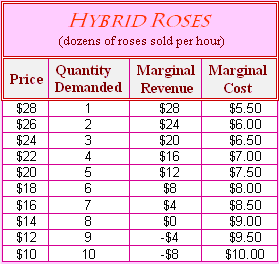
2404_Maximum Total Revenue.png

Can anybody suggest me the proper explanation for given problem regarding Economics generally?

   Related Questions in Microeconomics

  • Q : Examples of pure economic rent The

    The clearest illustrations of pure economic rent are payments: (1) for improvements which increase the productivity of resources. (2) to owners of unimproved land. (3) exceeding the productivity of a resource. (4) received by owners of homogeneous res

  • Q : Elasticity and profit maximization at

    When a monopolist which does not price discriminate produces output where is demand is unitarily elastic, in that case the firm will: (i) never be capable to maximize profit. (ii) maximize profit only when all costs are fixed. (iii) maximize profit wh

  • Q : Wages-Portion of costs Assume that a

    Assume that a firm with market power in output market wishes to grow up and that hiring more workers needs it to increase wages 8% for all the workers. Output prices will most likely: (1) Increase 8% to cover the wage raise. (2) Increase less than 8% as wages are only

  • Q : The perfect price discrimination

    Suppose a monopolist has zero marginal cost and faces the following demand curve D(p) = 10 - 2p (a) Graph the demand curve, the marginal revenue curve, and the rm's margin

  • Q : Scarcity of good in market problem In

    In the market of papayas: (1) A scarcity exists at P2. (2) Papayas are a free good at P0. (3) Papayas are presently a scarce good. (4) Consumer’s demand prices equivalent P2 at quantity Q2. (5) Equilibrium price for papayas be P0.

    Q : Illustration of zero Consumer Surpluses

    Clark pays $99.95 for the latest fishing rod. When Clark was willing to pay just a maximum of $99.95 for that fishing rod, his consumer surplus equivalents: (1) zero. (2) Clark would not be willing to buy the fishing rod at $99.95. (3) $99.95. (4) Clark would be bette

  • Q : Creating externalities to spread costs

    In efforts to offset specific failures of the private sector, government policy within a mixed-capitalist economy would be least reasonably intended at an objective of: (1) creating externalities to spread the costs of various activities across all me

  • Q : Explain Production Possibility curve

    Elucidate Production Possibility curve with the help of a diagram? Answer: The Production Possibility Curve refers to a curve that shows various production possibil

  • Q : Demand for Labor-Market Power Can

    Can someone please help me in finding out the accurate answer from the following question. The monopolist in product market will hire a labor to a point where the: (i) Marginal revenue product of the labor equivalent its marginal factor cost. (ii) The value of margina

  • Q : Bonds and Market Interest Rates

    Increases within market interest rates are probably to be related with: (1) people’s increasing desires for vast “nest eggs” for security while they retire. (2) bursting a speculative bubble into prices for hi-tech stocks. (3) increa