--%>

Output level of profit maximizing of competitive firm

The profit maximizing competitive firm in illustrated graph will: (i) produce output level q5. (ii) minimize total costs by producing output level q3. (iii) experience fixed costs equal to 0P3fq4. (iv) produce output level q4. (v) inevitably experience economic losses.
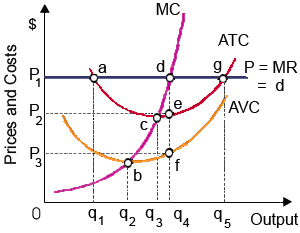
1858_Total Revenue1.png

How can I solve my Economics problem? Please suggest me the correct answer.

   Related Questions in Microeconomics

  • Q : Long run economic growth When people

    When people become optimistic about living longer and accordingly save more for their retirement years, in that case the decline into interest rates will tend to: (w) raise capital costs for business firms. (x) decrease investment expenditures. (y) di

  • Q : Problem on market demand for toys

    Booming toy sales throughout December usually reflect rises in: (1) The quantity of toys demanded.  (2) Market demand for toys. (3) Production costs. (4) Infantile consumerism. Can someone please help me in finding out the acc

  • Q : Unitarily elastic demand by fixing all

    A monopolist who does not price discriminate, that is: (w) cannot maximize profit by producing where demand is unitarily elastic. (x) will maximize profit where demand is unitarily elastic when all costs are fixed. (y) will maximize profit where deman

  • Q : Probable quantity of the good by price

    Price discrimination which successfully increases profit does NOT needs the firm to be capable to: (1) separate the market within different groups along with different demand elasticities. (2) maintain entry barriers which defend a firm’s market

  • Q : Changes in quantity demand determine

    When the price of Kellogg's Corn Flakes goes up by $1.89 to $2.05 and quantity demanded changes with 250 to 210, in that case the price elasticity of demand would be of: (w) .47 (x) .02 (y) 250. (z) 2.14. I need a

  • Q : Total revenue for profit-maximizing TR

    TR stands for total revenue for this profit-maximizing pure competitor as in below figure equals area: (i) 0Phq2. (ii) 0bgq2. (iii) Pbgh. (iv) 0aeq1. (v) daef.

    Q : Define change in demand Change in

    Change in demand: When change in demand takes place due to change in factor other than price, it is termed as change in demand.

  • Q : Loss efficiency to society from

    When the equilibrium price of wheat is $50 per ton and the marginal cost of the last ton of wheat generated is $70, there is: (w) an efficiency loss to society from over-production. (x) an efficiency loss to society from underproducti

  • Q : Total costs of profit-maximizing lumber

    This profit-maximizing lumber mill incurs total costs of approximately: (a) $2200 per day. (b) $3300 per day. (c) $4200 per day. (d) $5200 per day (e) $6200 per day.

    Q : Problem regarding to trade barriers for

    When the import market was within equilibrium before the Japanese government began subsidizing all autos exported by the amount dg, in that case U.S. car buyers would be: (w) pay P2 for a car previouslszy priced at P0. (x) suffer Q0 to