--%>

Output level at demand in a price-inelastic region

Babble-On maintains world-wide patents for software which translates any of 314 spoken languages within text, with automatic audio and text translations in any of the other three-hundred-thirteen languages. Babble-On will never intentionally produce as well as sell voice-recognition translation software at an output level where is: (w) marginal revenue [MR] is positive. (x) demand is in a price-elastic region. (y) marginal revenue [MR] is falling. (z) demand is in a price-inelastic region.
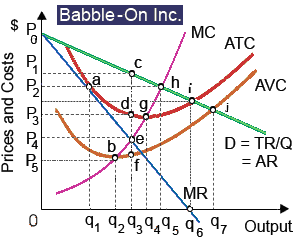
386_Market Power.png

How can I solve my Economics problem? Please suggest me the correct answer.

   Related Questions in Microeconomics

  • Q : Define revenue deficit Revenue deficit:

    Revenue deficit: Whenever revenue expenses are greater than revenue receipts, it is termed as revenue deficit.

  • Q : Collective Bargaining and Monopsonistic

    Can someone help me in finding out the right answer from the given options. Assume that sales of generic beds are highly competitive and Deluxe Beds is just significant employer in Nowhere, Nevada. When deluxe workers unionize and

  • Q : Problem on income and substitution

    Jim a vegetarian. All he eats is lettuce and cheese. His original budget constraint and utility maximizing bundle are illustrated in the graph shown below: 1531</span></p>
                                        </div>
                                        <!-- /comment-box -->
                                    </li>
   
   </td>
	</tr><tr>
		<td>
       
      <li>
                                        <div class=

    Q : Goods and service problem The market

    The market system's answer to the fundamental question "Who will get the goods and services?" is essentially: 1) "Those willing and able to pay for them." 2) "Those who physically produced them." 3) "Those who most need them." 4) "Those who get utility from them."

  • Q : Buyer beware-Laws and Regulations I

    I have a problem in economics on Buyer beware-Laws and Regulations. Please help me in the following question. Caveat emptor signifies: (i) Let the sellers beware. (ii) Sellers are the most excellent judges of the quality of their goods. (iii) Charge w

  • Q : Structure conduct performance paradigm

    From about 1890 till 1970, the “structure-conduct-performance paradigm” dominated theories concerning how firms behave in various kinds of markets. The word “conduct” in this context refers to these things as: (i) decisions by

  • Q : Labor Contracts-Featherbedding The

    The Restrictive work rules which need firms to employ more workers than essential are termed as: (i) Feather-bedding. (ii) Seniority contracts. (iii) Blacklisting regulations. (iv) Agency shop provisions. (v) Yellow dog contracts.

  • Q : Enter or leave the market by resources

    For a purely competitive industry in the long run: (i) several firms exit hence others may earn more than normal profits. (ii) established firms reap higher profits than newer firms. (iii) all resources are fixed for the industry as an entire. (iv) pe

  • Q : Perfectly inelastic supply of labor

    Glynn’s supply of labor is perfectly inelastic at: (1) point a. (2) point b. (3) point c. (4) point d. (5) point e. 2</span></p>
                                        </div>
                                        <!-- /comment-box -->
                                    </li>
   
   </td>
	</tr><tr>
		<td>
       
      <li>
                                        <div class=

    Q : Emerging by price discrimination

    Oligopolies are least expected to emerge due to: (1) economies of scale. (2) price discrimination. (3) strategic barriers to entry. (4) mergers. (5) legal barriers to entry. Can anybody suggest me the proper explan