--%>

Output and experiences by long run monopolistic competition

This monopolistic competitor generates Q0 output and experiences: (1) only normal accounting profits, and zero economic profits. (2) positive economic profits. (3) high costs because of excessive managerial salaries. (4) stagnation because of brand name deterioration. (5) economic losses.
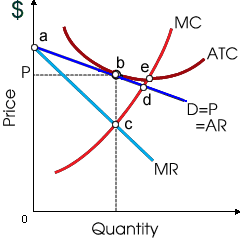
92_problem on Monopolistic Competition.png

I need a good answer on the topic of Economics problems. Please give me your suggestion for the same by using above options.

   Related Questions in Microeconomics

  • Q : Perfectly inelastic supply of labor

    Glynn’s supply of labor is perfectly inelastic at: (1) point a. (2) point b. (3) point c. (4) point d. (5) point e. 2</span></p>
                                        </div>
                                        <!-- /comment-box -->
                                    </li>
   
   </td>
	</tr><tr>
		<td>
       
      <li>
                                        <div class=

    Q : Define Fiscal deficit Fiscal deficit is

    Fiscal deficit is equavalent to excess of total expenditure over the sum of revenue and capital receipts excluding borrowings. That is, Fiscal deficit means borrowing of the government. Fiscal Deficit :T

  • Q : Output and price comparison with

    Compared to the output and price which are allocatively efficient by the vantage point of society, in that case a monopolist tends to: (w) produce less and charge a higher price. (x) maximize average profits when possible. (y) set price in the inelast

  • Q : Vigorous competition by firms in an

    Allocating scarce resources hence they are put to the uses which best satisfy consumer wants is facilitated through: (w) highly bureaucratic, centralized decision making. (x) tax breaks for wealthy people which “trickle down” to consumers. (y) vigorous com

  • Q : Least consistency for law of demand The

    The demand curve for socket sets from the list below which is least consistent along with the law of demand is: (w) demand curve D1D1. (x) demand curve D2D2.  (y) demand curve D3D3

  • Q : Total cost for monopolistic competitor

    Total cost for that monopolistic competitor in shown below figure equals area: (w) 0cbQ. (x) 0deQ + dcbe. (y) 0paQ   cpab. (z) All of the above.

    Q : Tacit collusion by oligopolists Tacit

    Tacit collusion through oligopolists is possible when: (w) agreed to by the government. (x) a price leader is visible. (y) the oligopolists succeed in forming a cartel. (z) very few firms control the market. How ca

  • Q : Neoclassical and heterodox One of my

    One of my friends can't succeed to get the answer of this question. Provide answer of this question. Economists of neoclassical argue that goods contain just subjective (or personal) use-value dimension; heterodox economists argue that goods contain use-value and soci

  • Q : Opportunity costs in different prices

    While a firm is NOT able of price discrimination: (w) various prices are charged for units of remotely related goods. (x) only opportunity costs are reflected in various prices for units of similar good. (y) any short term profit stimulates long run l

  • Q : Structure conduct performance paradigm

    From about 1890 till 1970 year, the “structure-conduct-performance paradigm” dominated theories regarding how firms behave in various types of markets. The term here “performance” in this context refers to those things as: (i)