--%>

Operations of monopolistically competitive firm

This monopolistically competitive firm as illustrated below produces Q units and its operations are demonstrated: (w) for the market period only. (x) as imposing economic losses of dcbe in the long run. (y) as generating short-run economic profits equal to cpab. (z) for long-run equilibrium.
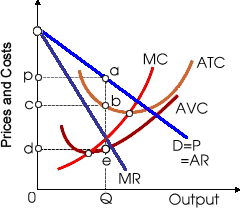
986_Monopolistic Competition.png

Please choose the right answer from above...I want your suggestion for the same.

   Related Questions in Microeconomics

  • Q : Pure economic profit on rate of return

    Owners of corporate stock obtain pure economic profit only to the extent which the rates of return realized by owning the stock exceed the: (1) interest rate that would have been produced by other investments entailin

  • Q : Rent controls fix rent in equilibrium

    Rent controls which fix rents below equilibrium will NOT: (w) maintain monetary rents down. (x) create shortages of rental housing. (y) stimulate non-market allocations of rental housing. (z) maintain the opportunity costs of housing down.

  • Q : Help economics !! The market system's

    The market system's answer to the fundamental question "Who will get the goods and services?" is essentially: 1) "Those willing and able to pay for them." 2) "Those who physically produced them." 3) "Those who most need them." 4) "Those who get utility from them."

  • Q : Lorenz curve as graphical device A

    A Lorenz curve is graphical device which can be utilized to portray the: (w) number of people below the poverty level. (x) conflict between high tax rates and high tax revenues. (y) relative inequalities in the distribution of a variable across a popu

  • Q : Positive economic analysis and normative

    Which of the given two statements involves positive economic analysis and which normative? How do the two type of analysis differ?a. Gasoline rationing (allocating to each year to each individual an annual maximum amount of gasoline whi

  • Q : Price elasticity of supply when demand

    When increased demand causes the price of main beluga caviar to climb from $2750 to $3250 per pound and consequently world production rises from 24 to 40 tons yearly, its caviar has a price elasticity of supply approx

  • Q : Demanding more labor in competitive fim

    A competitive firm will demand more labor when: (1) technological advances favor automation. (2) the price of the firm's output rises. (3) more firms enter the industry. (4) the value of the marginal product is below the wage rate. (5) workers utilize

  • Q : Profit-maximizing competitor in short

    This profit-maximizing pure competitor would close down within the short run when the price fell below the price resultant to: (i) point c. (ii) point d. (iii) point e. (iv) point f. (v) point g.

    Q : Kinked Demand by decreasing price In

    In this kinked demand curve model as in given graph, when this firm operated at point a and lowered its price by P2 to P1 and other firms in the industry also lower prices, in that case this firm will move from point a to: (w) po

  • Q : Felicific calculation of utilitarianism

    The supposition that a ‘felicific calculation’ gives a proficient guide for fitting punishment to the crime committed is an integral portion of: (1) Gresham’s Law that ‘Bad will drive out Good’. (2) Jeremy Bentham’s utilitarianism.