--%>

Operates a profit-maximizing firm

When this profit-maximizing firm as in illustrated graph can’t price discriminate in that case this will operate where is: (1) accounting profit is positive but economic profit is zero. (2) the demand curve facing the firm is the least price elastic. (3) total revenue equals the sum of marginal fixed costs. (4) marginal revenue most greatly exceeds average revenue. (5) marginal costs equal variable costs.
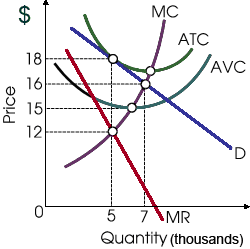
922_Monopolistic Competition1.png

Hello guys I want your advice. Please recommend some views for above Economics problems.

   Related Questions in Microeconomics

  • Q : Types of good An increase in the income

    An increase in the income of consumer X leads to a fall/down in the demand for that good by the consumer. What is good X termed? Answer: Normal good

  • Q : C why cotton textile tndustry is a

    why cotton textile tndustry is a microeconomic study

  • Q : Define change in demand Change in

    Change in demand: When change in demand takes place due to change in factor other than price, it is termed as change in demand.

  • Q : Preferance of food after income rises

    Assume that, for you, lobster is an ordinary good and peanut butter is a poorer good. When your income increases, you will probably consume: (1) Greater of both goods. (2) Less of both goods. (3) Greater peanut butter and less lobster. (4) Greater lobster and less pea

  • Q : Causes for diminishing returns to factor

    What are the causes for diminishing returns to factor? Answer: 1) Over utilization of

  • Q : Economic foundations of the single tax

    The economic foundations of the single-tax progress were first presented through: (1) British Prime Minister Lloyd George. (2) John Stuart Mill. (3) Henry George. (4) David Ricardo. (5) George Stigler. How can I so

  • Q : Low-income developing countries select

    select the right answer of the question. Which of the below nations are low-income developing countries (DVCs), according to the World Bank? 1) country A only  2) countries A, D, and E  3) countries A and E  4) countries A, B, D, and E

    Q : Theory of imperfect competition An

    An extensive theory of imperfect competition was initially developed by: (1) John Maynard Keynes. (2) Antoine Augustin Cournot. (3) Joan Robinson. (4) Joseph Schumpeter. (5) Thorstein Veblen. How can I solve my

  • Q : Problem regarding to tax wedges in

    In equilibrium, a tax upon a good tends to because of the: (1) supply to exceed the demand. (2) quantity supplied to exceed the quantity demanded. (3) demand prices of consumers to exceed the supply prices of sellers. (4) competitive

  • Q : Technological advances in natural

    Natural barriers to entry may be overcome across time from: (w) cut-throat competition. (x) elimination of patent laws. (y) technological advances. (z) rigorous enforcement of antitrust laws. How can I solve my