--%>

On which point demand appears to be unitarily elastic

On this demonstrated figure of demand curve for DVD games, demand appears to be approximately unitarily elastic at: (w) Q = O, P = $50. (x) Q = 10, P = $O. (y) Q = 5, P = $25. (z) No point on the demand curve.
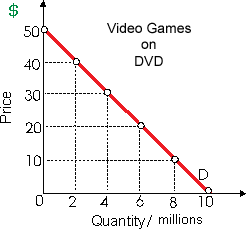
1507_Price Elasticity of Demand2.png

Can anybody suggest me the proper explanation for given problem regarding Economics generally?

   Related Questions in Microeconomics

  • Q : Primary claimants to the firms income

    I have a problem in economics on Primary claimants to the firm’s income stream. Please help me in the following question. Primary claimants to the firm’s income stream would be least probable to comprise: (i) Entrepreneurs or owners of general stock. (ii)

  • Q : Devaluation and depreciation of

    Distinguish among devaluation and depreciation of domestic currency

  • Q : Capital Market in Private Economy This

    This capital market is within this illustrated figure a closed private economy. The first plans of savers and investors are demonstrated as curves S0 and I0. There market equilibrium will exist at: (1) point a. (2) point b. (3) point

  • Q : Opportunity costs in different prices

    While a firm is NOT able of price discrimination: (w) various prices are charged for units of remotely related goods. (x) only opportunity costs are reflected in various prices for units of similar good. (y) any short term profit stimulates long run l

  • Q : Under negative income tax the net income

    Under the negative income tax system demonstrated in this figure, where a family of four all along with earned income of $60,000 yearly would have a net [after-tax] income of: (1) $37,500 per year. (2) $42,500 per year. (3) $50,000 per year. (4) $55,0

  • Q : Define forward shifting of tax burden

    The greater the price elasticity of demand associate to the price elasticity of supply, then the: (i) greater the legal incidence of any tax burden. (ii) smaller the forward shifting of any tax burden. (iii) smaller the backward shift

  • Q : Right-to-Work Laws problem Can someone

    Can someone help me in finding out the right answer from the given options. The provisions of Taft Hartley Act did not proscribe: (i) Secondary boycotts. (ii) Closed shops. (iii) Jurisdictional strikes. (iv) Right-to-work laws.

  • Q : Problem on organizing the business The

    The individual who wants to begin up a business, however who not want to risk in losing personal property if the business fails, must organizes the business as: (1) Sole proprietorship. (2) Partnership. (3) Corporation. (4) Unlimited partnership.

    Q : Demand of consumers-supply of seller

    Consumers’ demand prices and sellers’ supply prices may be different in equilibrium due to: (w) arbitrage. (x) expectations about availability. (y) the invisible hand. (z) government subsidies or tax wedges.

  • Q : Purely competitive firms in long-run

    Purely competitive firms in long-run equilibrium as: (w) should use the most efficient technology available. (x) follow cut throat policies to produce more than society demands. (y) produce output levels where TC = TR = MR = MC = P = AR = AC. (z) have