--%>

Occurrence of socially optimal production

The socially optimal production of penicillin arises while quantity: (a) Q1 is produced and sold at price P1. (b) Q1 is produced and sold at price P3. (c) Q2 is produced and sold at price P2. (d) Q3 is produced and sold at price P1. (e) Q3 is produced and sold at price P3.
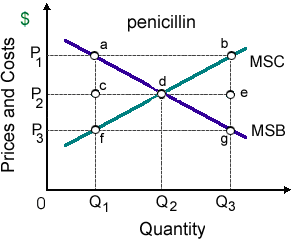
2119_Efficiency and Welfare.png

Can anybody suggest me the proper explanation for given problem regarding Economics generally?

   Related Questions in Microeconomics

  • Q : Monopolies over brand name products of

    Several firms have monopolies over brand name products, although face competition from: (w) international cartels. (x) oligopolistic rivals. (y) producers of close substitutes for their products. (z) intra-firm rivalry.

    Q : Revenue expenditure Why payment of

    Why payment of interest is treated as revenue expenditure? Answer: Since it does not cause any decrease in the liability of government.

  • Q : Weekly economic profit of profit

    The profit maximizing firm currently here in illustrated graph can generate a weekly economic profit of approximately: (1) $29,000. (2) $31,500. (3) $34,000. (4) $36,500. (5) $39,000.

    Q : Prevent operating in long run by

    A monopolist will prevent operating within the long run unless its economic profit is: (i) zero. (ii) positive. (iii) greater than accounting profit. (iv) zero or greater. (v) zero or less. I need a good answer on

  • Q : Price elasticity of demand coefficient

    In this demonstrated figure, there the price elasticity of demand coefficient is: (1) one at the midpoint. (2) greater than one in range a. (3) less than one in range b. (4) falling along with movements down along the demand curve. (5) All of the abov

  • Q : Freedom to enter or leave the market in

    Purely competitive industries are not described by: (i) numerous potential buyers. (ii) product homogeneity. (iii) numerous potential sellers. (iv) freedom to enter or leave the market within the short run. (v) power to adjust quantities although no p

  • Q : Experiencing the economies of Scale Let

    Let assume that an auto manufacturer which can produce 10 cars at an average cost of $8000 per car. When the manufacturer enlarges output to 100 cars, then the average cost of production falls to $5000 per car. This firm is experiencing the: (1) Raised demand. (2) Eco

  • Q : Specific market price The difference

    The difference among maximum amount which consumers would willingly pay for a particular quantity of a good and the amount they really pay at a specific market price is termed as: (i) Discount rate. (ii) Mark-up factor. (iii) Familial gains. (iv) Hous

  • Q : Social opportunity cost of resource

    Economic rent is: (w) income received by a factor owner in excess of the social opportunity cost of supplying the resource. (x) the difference between a firm’s revenues and the sum of the fixed and variable costs of production. (y) a form of eco

  • Q : Definitions of Poverty by Researchers

    Some researchers have attempted to define poverty: (1) as the lowest 20% of the income distribution. (2) through estimates of the fundamental needs for families having various characteristics. (3) by estimating the costs of the minimum caloric intake