--%>

Nonlinear kinked demand curve

Within this "kinked-demand curve" model, that firm views the demand curve this faces as the: (w) linear "kinked" demand curve aD2 for all prices. (x) linear "kinked" demand curve D1D1 for all prices. (y) nonlinear "kinked" demand curve D1cD2. (z) nonlinear "kinked" demand curve acD1.
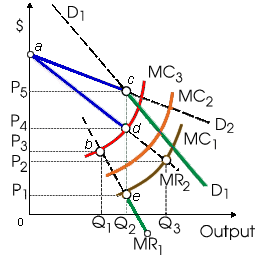
1930_Kinked Demand Curve.png

I need a good answer on the topic of Economics problems. Please give me your suggestion for the same by using above options.

   Related Questions in Microeconomics

  • Q : What Determinants of Supply include

    Determinants of supply do not comprise: (1) Government regulations. (2) Technology. (3) Resource prices. (4) Prices for other producible goods. (5) Tastes and preferences. Can someone please help me in finding out the accurate answ

  • Q : Exploitation of Labor-average revenue

    The Exploitation might not exist even when the wage a worker is paid is less than worker’s: (1) Average revenue product. (2) Marginal revenue product. (3) Marginal factor cost. (4) The value of marginal product. Can someone p

  • Q : Problem on purchasing newly-issued

    Can someone please help me in finding out the accurate answer from the following question. The individual who purchases a newly-issued corporate bond is: (i) Borrowing money from corporation. (ii) Lending money to corporation. (iii) Purchasing a share of corporation.

  • Q : Example of how marginal utility

    An illustration of how marginal utility diminishes takes place when: (1) Todd only requires 180 screws for his bike repair shop however purchases a box of 200 screws. (2) Amy Sue decides she would instead contain 150 hogs than 151 on her pig farm. (3)

  • Q : Determine probable price taker Of the

    Of the given firms, the probably to be a price taker would be: (1) Microsoft. (2) Wal-Mart. (3) Toyota. (4) the Los Angeles Lakers. (5) the biggest wheat farm in Canada. I need a good answer on the topic of

  • Q : Relative profitability and efficiencies

    From around 1890 until 1970 year, the “structure-conduct-performance paradigm” dominated theories concerning how firms behave in various types of markets. Here the word “performance” in this context consider to things as: (i) d

  • Q : Problem on Ceteris Paribus Can someone

    Can someone please help me in finding out the accurate answer from the following question. Supposing everything to be constant apart from the variables being studied is termed as the: (1) Ceteris paribus assumption. (2) Ex post facto assumption. (3) Post hoc ergo prop

  • Q : Long-run purely competitive industry

    For a purely competitive industry in the long-run: (w) neither net entry nor net exit of firms will arise. (x) firms will experience significant economies of scale. (y) the typical firm’s economic profit will exceed its accounting profit. (z) th

  • Q : Ratio of percentage changes in quantity

    The ratio of the percentage change within the quantity of beef sold over the percentage change within the price of pork is: (1) price elasticity of demand for beef. (2) price elasticity of demand for pork. (3) income elasticity of dem

  • Q : Differentiate Income and Wealth One

    One main difference between income and wealth is which: (w) wealth is inherited, income is earned. (x) income generates wealth, wealth cannot generate income. (y) all income is subject to taxation, most wealth is not. (z) wealth is a stock variable, i