--%>

Net income under the negative income tax

Under the negative income tax system demonstrated in this given figure, a family of four along with earned income of $75,000 per year would have a net as [after-tax] income of: (i) $15,000 per year. (ii) $30,000 per year. (iii) $45,000 per year. (iv) $60,000 per year. (v) $75,000 per year.
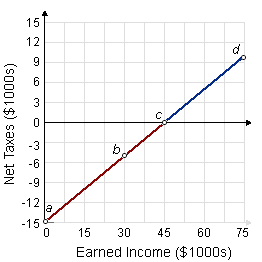
1127_Problem on Negative Income Tax.png

How can I solve my Economics problem? Please suggest me the correct answer.

   Related Questions in Microeconomics

  • Q : Price times quantity in total revenue

    Total revenue equals: (w) price times quantity. (x) marginal revenue times marginal cost. (y) profit per unit of output. (z) total cost minus profit. Please choose the right answer from above...I want your suggesti

  • Q : Problem on Vertical Mergers Assume that

    Assume that Ben & Jerry’s Ice Cream purchases a big dairy farm and some sugar cane farms. Ben and Jerry’s Ice Cream is practicing: (i) Vertical integration. (ii) Horizontal integration. (iii) Monopolization. (iv) Industrial concentration. (v) Conglomer

  • Q : Elastic Demand for Labor At existing

    At existing wages the LEAST elastic demand for the labor is most likely faced by: (i) Unskilled harvest workers. (ii) Garment workers. (iii) Assembly line workers. (iv) Dentists. Can someone please help me in findi

  • Q : Proprietorships and

    Can someone please help me in finding out the accurate answer from the following question. The sole proprietorship owned and executed by the lone individual is at a drawback whenever compared to the corporation since it lacks relatively: (i) Flexible legal options reg

  • Q : Hire labor at any amount in purely

    When this purely competitive firm can hire any amount of labor at pre hour wage of $9 per worker, in this given figure, as it will hire: (1) L2 workers. (2) L3 workers. (3) L4 workers. (4) L5 workers. (5) L<

  • Q : Social opportunity cost of resource

    Economic rent is: (w) income received by a factor owner in excess of the social opportunity cost of supplying the resource. (x) the difference between a firm’s revenues and the sum of the fixed and variable costs of production. (y) a form of eco

  • Q : Public utilities in natural monopoly

    Public utilities are generally: (1) regulated natural monopolies. (2) competitive non-profit corporations. (3) consequences of diseconomies of scale in production. (4) only subject to laissez-faire regulation. (5) operated by the federal government.

  • Q : Nonexistent market supply and power

    HoloIMAGine has patented a holographic technology which creates 3-D photography obtainable to consumers. There is a market supply curve for HoloIMAGine technology: (w) nonexistent since price-maker firms simultaneously set prices as well as quantities

  • Q : Minimum wage law for poor workers A

    A minimum wage law does NOT make pressures which tend to: (1) benefit high wage workers. (2) cause unemployment among unskilled workers. (3) uniformly help poor workers. (4) increase teenage unemployment. (5) foster discrimination.

    Q : When Shortages occur Shortages take

    Shortages take place whenever the market price: (1) Most greatly surpasses the average person’s demand price. (2) Is above the usual seller’s supply price. (3) Equivalents production costs plus the maximum possible gain. (4) Lies beneath t