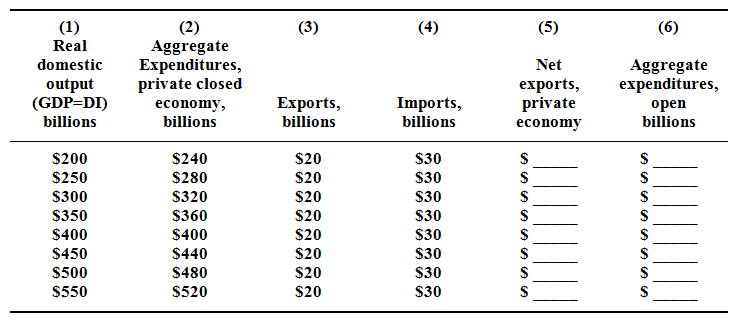
Multiplier for private closed economy
For private closed economy, the data of columns 1 & 2 of the below table is given. Determine multiplier in this example?
Expert
Since each rise of $50 billion in GDP raise aggregate expenditures by $40 billion, the MPC is .8 and so the multiplier is 5.
Initiative: The power of electors to propose statutes or Constitutional amendments and to accept or reject them. An initiative should be limited to a single subject and be filed with the Secretary of State with the suitable number of voter signatures
Schedule 8: A detailed listing produced from the State Controller's Office payroll records for a department of its past, present, and budget year positions as of June 30 and updated for the July 1. This listing should be reconciled with each and every
Pooled Money Investment Account (PMIA) It is a State Treasurer's Office accountability account maintains by State Controller's Office to account for short-term investments procured by the State Treasurer's Office as designated by the Pooled Money Inve
Normal 0 false false
Explain non diversifiable risk? How is it measured? Unless the returns of one-half the assets into a portfolio are entirely negatively correlated along with the other half-that is extremely unlikely-some risk will
Change Book System: The system the Department of Finance employs to record all the legislative modifications (comprising changes stated by the Administration and approved by the Legislature) made to the Governor's Budget and the last actions on the bu
Which ratios would a potential long-term bond investor is most interested in? Describe. Current & potential lenders of long-term funds, such like banks & bondholders, are interested in debt ratios. While a business's debt ratios ri
Abolishment of Fund: It is a closure of fund pursuant to the operation of law. The funds might also be administratively eliminated by the Department of Finance with the concurrence of the State Controller’s Office. Whenever a sp
Hello, You folks recently completed an order for me. I'm very impressed and much thanks in advance. I'd like to submit more problems (8 attached) if you can have the same expert work on these please? Some of the #'s were slightly modified from my previous order, so should be easier than starting
Statewide Cost Allocation Plan (SWCAP): It is the amount of state administrative, General Fund costs (example, amounts expended by the central service departments like the State Personnel Board, State Treasurer’s Office, State C
18,76,764
1934201 Asked
3,689
Active Tutors
1458264
Questions Answered
Start Excelling in your courses, Ask an Expert and get answers for your homework and assignments!!