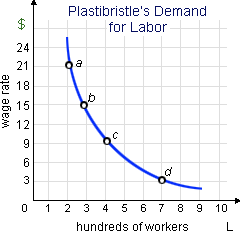
Most wage elastic demand for labor
For labor Plastibristle’s demand is most wage elastic at: (1) point a. (2) point b. (3) point c. (4) point d. Hello guys I want your advice. Please recommend some views for above Economics problems.
For labor Plastibristle’s demand is most wage elastic at: (1) point a. (2) point b. (3) point c. (4) point d.
Hello guys I want your advice. Please recommend some views for above Economics problems.
By the following choices in this illustrated graph, this worker would be happiest at point: (w) point a. (x) point b. (y) point c. (z) point d. Q : State the causes for downward sloping State the causes for downward sloping of demand curve?
State the causes for downward sloping of demand curve?
States the Scarcity Definition in economics?
Differentiate between Private Cost and Social Cost.
answer written below is correct for the question detail exception of demand curve ?
Illustrates the term long run production function?
The observations that whenever output is expanded, the costs ultimately grow faster than output, and that the enjoyment people receive from consuming additional units of a specific good ultimately declines, both pursue logically from the law of: (1) Unexpected effects
demand function is: QY = -8,000 - 5,000PY + 192A + 120I + 2,000PX (6,000) (1,000) (120) (80) (800) R2 = 91% Here QY is quantity (measured in units) of Product Y demanded in the current period, A is hundreds of dollars of advertising ($00), I is thousands of dollars of disposable income per ca
Why is wealth definition of economics criticized?
Illustrates the conditions of price discrimination?
18,76,764
1943693 Asked
3,689
Active Tutors
1415091
Questions Answered
Start Excelling in your courses, Ask an Expert and get answers for your homework and assignments!!