--%>

Monopolistic competitive firm in normal accounting profits

This monopolistically competitive firm in illustrated figure produces Q units as well as experiences: (1) economic profits equal to 0cbQ. (2) economic losses equal to cpab. (3) more than normal accounting profits. (4) marginal cost in excess of average total cost. (5) total revenue less than total cost.
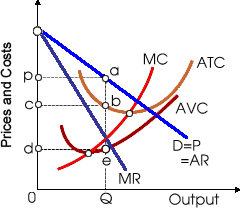
971_Monopolistic Competition.png

Hey friends please give your opinion for the problem of Economics that is given above.

   Related Questions in Microeconomics

  • Q : Problem regarding to First Mover

    Carlos and Ivana both are roommates and friends. Carlos and Ivana eat together regardless of who cooks. When this game is repeated almost daily, and on Thursday, Ivana is permitted to pick first, the probable result is that: (w) neither Carlos nor Ivana cook, nor do t

  • Q : Value of the Marginal Product I have a

    I have a problem in economics on Value of the Marginal Product. Please help me in the following question. Value of the marginal product is stated as: (1) MPP × P. (2) MPP × MR. (3) MPP × MC. (4) MPP × MRC.

    Q : Increasing return to a factor Describe

    Describe the likely behaviour of total product beneath the phase of increasing return to a factor.

  • Q : Prices and costs in monopoly market

    When this monopoly generates Q units: (1) P > MC. (2) MR = MC. (3) total revenue total cost is maximized. (4) MSB > MSC. (5) All of the above.

    Q : Problem on equilibrium market price I

    I have a problem in economics on equilibrium market price. Please help me in the following question. The equilibrium market price subsists only if: (1) Quantity demanded equivalents the quantity supplied. (2) Surpluses exceed the shortages. (3) Expert

  • Q : Influence of good on opportunity cost

    The law of demand defines that, all as well constant, consumers will obtain: (i) More of a good, the lower its opportunity cost. (ii) Less of any good, higher the prices of its substitutes. (iii) Advertised goods more often than generic products. (iv) Greater luxuries

  • Q : Pure competition market A purely

    A purely competitive market would NOT be illustrated by: (1) many potential buyers and sellers. (2) each buyer or seller being a price taker. (3) an absence of long-run barriers to entry or exit. (4) aggressive advertising to compare brands. (5) a sin

  • Q : Elasticity Which of the statements

     Which of the statements regarding elasticity is correct? A) Supply is more elastic in the short run than in the long run. B) Demand is more elastic in the short run than in the long run. C) Demand is more elastic when a large number of substitute goods are avail

  • Q : Immunity of Corporate giants in market

    Can someone help me in finding out the most precise answer from the given options. The Corporate giants are not immune to the market pressures since: (i) They experience the diseconomies of scale. (ii) Advertising decreases the barriers to entry. (iii) Profits give an

  • Q : Additionally productive work American

    American workers tend to be additionally productive than their counterparts within Asia since they have: (1) less capital to work along with. (2) more capital to work with. (3) lower marginal products. (4) been instilled along with a stronger work eth