--%>

Modeling Language for SPIN-Promela

Modeling Language: The modeling language used for SPIN is called Promela (Process Meta Language). In fact, the name SPIN stands for Simple Promela Interpreter. Promela is a powerful C-like specification language with a variety of synchronization primitives that enables construction of models of distributed systems. Promela is a guarded command language for specifying possibly non-deterministic system behaviors in a distributed system design. It allows for the dynamic creation of concurrent processes which communicate synchronously or asynchronously via message channels.

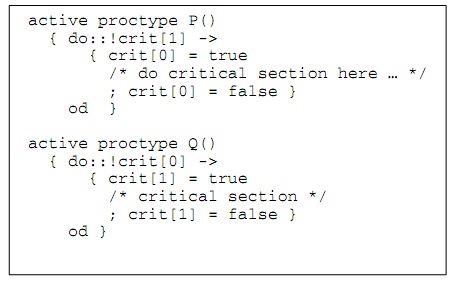
For example, the following Promela specification describes two processes P and Q that synchronize over a critical region.
2110_promela1.jpg

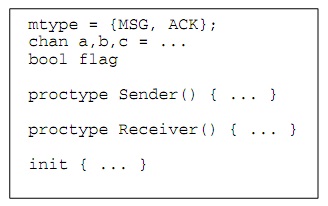
A Promela model consists of declarations of types, channels, variables, and processes, as well as facilities for initializing the processes. For example,
2359_promela2.jpg

A model consists of a set of concurrent processes, each in turn consisting of a set of atomic guarded actions or transitions. An action whose guard is true is called enabled and can be executed; otherwise, it is disabled and cannot be executed. Actions are not really executed concurrently; rather, they are non-deterministically interleaved, and this is used to model concurrency. Also processes do not have to terminate, which is useful when modeling reactive systems.

   Related Questions in Programming Languages

  • Q : Define Null reference Null reference :

    Null reference: A value utilized to mean, `no object'. Employed whenever an object reference variable is not referring to the object.

  • Q : Define the term Sound card Define the

    Define the term Sound card: It is a hardware device employed to turn digital data into sound.

  • Q : Define the reasons of Process Handle

    Define the reasons of Process Handle Table.

  • Q : Homework Assignment How much would it

    How much would it cost to do a basic program within the given requirements?

  • Q : Which is the tool having demand within

    Which is the excellent tool one should learn, which is the tool having demand within the market?

  • Q : Define Inner class Inner class : A

    Inner class: A class defined within an enclosing method or class. We use the word to refer to non-static nested classes.

  • Q : What is Runtime stack Runtime stack :

    Runtime stack: It is a stack structure maintained by the Java Virtual Machine which records that methods are presently being executed. The most of late entered technique will be at the top of the stack and the main technique of an application will be

  • Q : Describe Timers Timers: While time

    Timers: While time values usually cannot be reduced in the target system, their usage can be encapsulated as an abstraction which can be replaced easily (e.g., by a non-deterministic choice) during model checking.

  • Q : What is Server Server : Something which

    Server: Something which gives a service. The Web server delivers resources to its clients, for example. Whenever the server is an object, this is the recipient of messages from its object clients.

  • Q : Define Stream class Stream class : An

    Stream class: An input stream class is one which delivers data from its source (frequently the file system as a series of bytes. Likewise, an output stream class will write byte-level data. The stream classes must be contrasted with the operation of r