--%>

Minimum possible economic losses

Hello guys I want your advice. Please recommend some views for below illustrated figure of Economics problem that for this profit-maximizing pure competitor, area Pbgh signifies: (1) fixed cost (TFC). (2) average fixed cost (AFC). (3) losses, but the minimum possible economic losses. (4) maximum positive economic profits. (5) rate of return on investment.
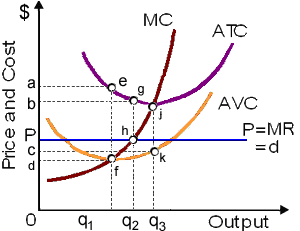
2028_profit-maximizing.png

Can anybody suggest me the proper explanation for given problem regarding Economics generally?

   Related Questions in Microeconomics

  • Q : Problem on Minimum Wage Sec. A :The

    Sec. A:The Bureau of Labor Statistics of a small state has asked you to analyze a minimum wage policy to support unskilled workers in the State’s local economy, which is still suffering from the effects of the recession.  Based on

  • Q : Vigorously competitive market

    Economic rents which can be capitalized are least possible to arise by: (1) production cost advantages. (2) proprietary knowledge. (3) being first to market a differentiable new product or to innovate a new production technology. (4) a vigorously comp

  • Q : Payments in dictionary of economic The

    The economic word for payments for the utilization of capital is: (1) dividends. (2) interest. (3) profit. (4) residuals. (5) royalties. I need a good answer on the topic of Economics problems. Ple

  • Q : Find price elasticity of demand for

    Suppose yearly steel sales double to 80 million tons while the price falls $40 per ton, to $180 per ton. Therefore price elasticity of demand for steel is approximately: (w) 3.333. (x) 10.000. (y) 2.500. (z) 6.667.

    Q : Marginal Utilities and Demand Prices

    Can someone help me in finding out the right answer from the given options. Rational individual consumers tend to purchase goods until the relative market prices for each and every goods purchased are proportional to all individuals: (i) Cost or benefit ratio. (ii) Op

  • Q : Complete equilibrium by distribution of

    When the economy was in a complete equilibrium, in that case the distribution of income would be precisely proportional to the distribution of: (a) taxation. (b) inheritance. (c) luck. (d) wealth.

  • Q : Profit from cost structures and market

    When cost structures and the market demands facing each of the given types of firms were identical, in that case the greatest profits would be generated through a: (1) pure monopolist. (2) price discriminating monopolist. (3) perfectly competitive fir

  • Q : Wage Rate and Exploitation problem

    Assume that a firm possessesing both monopsony power as the employer and market power in its output market, however that can neither wage neither discriminate nor price discriminate. In equilibrium, in its labor market for workers, of the given variables the lowest va

  • Q : Determine total revenue when maximizes

    Total revenue when this firm maximizes economic profits would be: (w) $72,000 per period. (x) $80,000 per period. (y) $96,000 per period. (z) $100,000 per period.

    Q : Difference between opportunity cost and

    Differences among the opportunity cost of a purchase through a consumer and the seller’s price are increased through: (w) taxes. (x) intermediaries. (y) competition. (z) speculators. Can anyb