--%>

Minimum average costs at production

Nostalgia Corporation could accomplish minimum average costs for Silver Screen DVDs when this produced: (i) 4 million DVDs. (ii) 6 million DVDs. (iii) 8 million DVDs. (iv) 10 million DVDs. (v) 12 million DVDs.
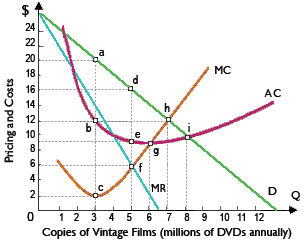
387_maximize profit.png

Hey friends please give your opinion for the problem of Economics that is given above.

   Related Questions in Microeconomics

  • Q : Pure economic profit in the short run

    Monopolistically competitive firms: (w) profit by erecting durable barriers to entry and exit. (x) may realize pure economic profit in the short run, but not in the long run. (y) supply homogenous goods. (z) produce where marginal cost is at its minim

  • Q : Demand and supply An increase in

    An increase in consumer desire for strawberries is most likely to: A) increase the number of strawberry pickers needed by farmers. B) reduce the supply of strawberries. C) reduce the number of people willing to pick strawberries. D) reduce the need for strawberry pic

  • Q : Break-even on profit-maximizing strategy

    Robomatic Corporation would exactly break-even upon its RoboMaids when, instead of exactly identifying its profit-maximizing strategy, this: (i) operated at point i, charging only $10,000 per unit and producing 16,000 robots. (ii) pri

  • Q : Marginal Benefits The marginal

    The marginal advantage/profit to you of a usual activity in which you engage tends to: (i) Raise as long as you enjoy the activity. (ii) Eventually reduce as you do more of activity. (iii) Stabilize when the market price of doing the activity stay constant. (iv) Impro

  • Q : Most likely resources in short run I

    I have a problem in economics on most likely resources in short run. Please help me in the following question. The most probable of the given resources to be fixed for the farmer in short run would be: (1) Land. (2) Labor. (3) Fertilizer. (4) All the above would be of

  • Q : Demand and supply influences

    Changes in both demand and supply of a commodity might or might not influence its equilibrium price. Describe.

  • Q : LEAST dependency Demands for labor

    Demands for labor depend LEAST upon the levels of: (w) labor productivity. (x) technology as well as amounts of other resources employed. (y) demand for final products. (z) trade off among work (creating income) and leisure.

    Q : Prices and outputs in short run All

    All output markets which are less than purely competitive are characterized through: (1) domination of the market by some large firms. (2) individual firms that are very small to affect their prices. (3) freedom of entry and exit in the long run. (4)

  • Q : Equilibrium in the long run This would

    This would be a fallacy to suppose that: (w) a purely competitive firm’s demand curve is perfectly elastic. (x) a purely competitive firm’s supply curve is the marginal cost above the minimum point of the AVC. (y) purely competitive firms generate where MR

  • Q : Market demand of purely competitive

    How purely competitive industries respond to raises in market demand depends upon: (w) the time period considered. (x) immediate quantity adjustments and longer run price adjustments. (y) each firm’s average total costs. (z) the slope of the mar