--%>

Minimizes losses and maximizes profits by firm

When Firm B in demonstrated graph successfully minimizes losses and maximizes its profits that have: (1) covered overhead while incurring short-run economic losses. (2) potential economic profit of Pbgh per period. (3) total costs equal to 0phq2. (4) produced the socially optimal rate of output for the entire market. (5) covered its variable costs but is incurring short-run economic losses.
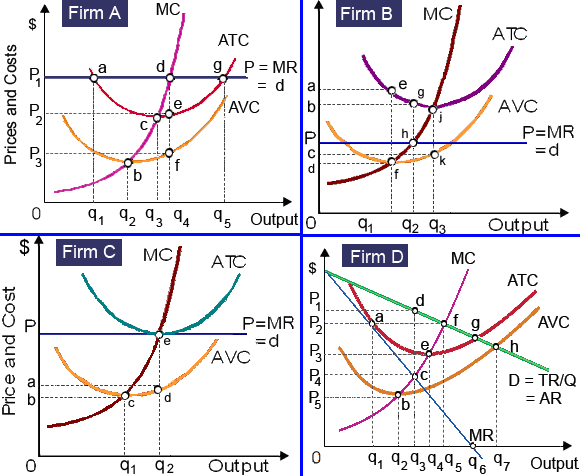
2227_Market Structures.png

I need a good answer on the topic of Economics problems. Please give me your suggestion for the same by using above options.

   Related Questions in Microeconomics

  • Q : Marginal Rate of transformation Define?

    Define? Marginal Rate of transformation?? Describe with the help of an illustration.

  • Q : Monopsonist problem I have a problem in

    I have a problem in economics on Resources and Products Flow Model. Please help me in the following question. The firm which is the sole buyer of a specific good or resource is the: (i) Monopsonist. (ii) Conglomerate. (iii) Price discriminator. (iv) P

  • Q : Nominal Interest Rates Nominal interest

    Nominal interest rates are: (w) always identical to real interest rates. (x) the percentage of monetary premiums paid per time era for the use of money. (y) determined by the size of economic rents. (z) the percentage of purchasing power transferred b

  • Q : Income and Substitution effects problem

    Economists decompose how the consumers react to a change in price of a good into the: (1) Diminishing marginal utility effect and indifference effect. (2) Indifference effect and enhancement effect. (3) Net utility effect and preference effect. (4) Income effect and s

  • Q : Price floors with government purchases

    Suppose the U.S. wheat market is primarily in a stable equilibrium upon S0D0. Assume now that the government institutes a legal price floor at P3 per bushel of wheat. When the government will buy and store any resulting surplus

  • Q : Product differentiation in gain

    Monopolistic competitors: (1) base decisions on the anticipated reactions of their many individual competitors. (2) can easily enter but not exit industries. (3) may sometimes act like monopolists and gain economic profits in the short run because of

  • Q : Marginal cost of capital What do you

    What do you mean by the marginal cost of capital?

  • Q : Demand when price of good or resource

    When the price of a good or resource drops, the demands for: (i) That good or resource raise. (ii) Complementary goods or resources reduce. (iii) Substitute goods or resources reduce. (iv) Luxury goods and inferior resources drop.

  • Q : Labor Force Participation Rates The

    The percentage of a specific population who is either unemployed or employed or is termed as the: (i) Labor force participation rate. (ii) Work-force proportion. (iii) Income-leisure loss curve. (iv) Substitution effect dominance rate. (v) Labor supply.

  • Q : Operating analytic Time of

    When this purely-competitive firm makes output level Q, this is operating within the: (i) technological long run. (ii) long run. (iii) short run. (iv) shut down period. (v) boom period of the business cycle.